- Archaeological News
-
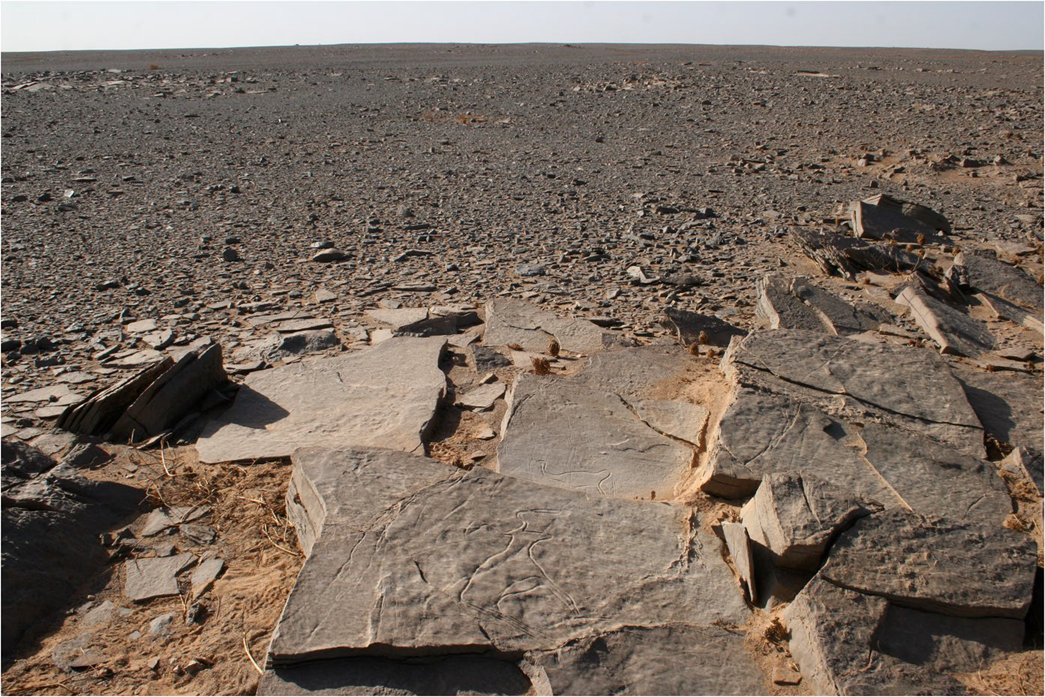
 Rock engraving near the Lawash el Telli funerary monument in Western Sahara, depicting a bovid and an ostrich within the wider Sluguilla Lawash rock-art landscape.
Image Credit:
Soler et al., African Archaeological Review (2026)
4,300-Year-Old Desert Tomb Gives Western Sahara Monument Its First Firm Date
An archaeological excavation in Western Sahara has provided the first direct evidence for the age and funerary purpose of a distinctive type of prehistoric stone monument known as an antennae tumulus, revealing that one such structure was built for burial roughly between 2500 and 2150 BCE.
These monuments consist of a stone mound from which two long, narrow stone alignments extend like antennae. They occur across Western Sahara and neighbouring parts of the Sahara, yet archaeologists have rarely excavated them. Their use as tombs had long been suspected, but direct evidence remained scarce, and no absolute chronology had previously been established for this monument type in the Atlantic Sahara.
The newly studied monument lies at Wadi Lawash el Telli, near the eastern edge of the large Sluguilla Lawash rock-art area in northern Western Sahara. The surrounding landscape is an extremely arid gravel plain, while nearby stretches of the wadi contain hundreds of engraved rocks depicting animals and other figures. The tomb’s proximity to this rich archaeological landscape makes it especially interesting, although the researchers caution that physical proximity alone doesn’t prove that the monument and the rock art belonged to the same people or period.
The monument itself extends for 54.5 metres. At its western end lies an oval stone mound measuring about 12.5 by 10 metres, while two stone alignments extend eastward from its northern and southern sides. Builders used locally available Devonian limestone slabs and blocks without mortar, suggesting that construction required organization and labour but not highly specialized extraction or transport techniques.
Excavation exposed a simple internal structure. Beneath the outer accumulation of stone, archaeologists encountered a covering formed from large limestone slabs. Below it lay the remains of a single person deposited directly on the natural ground, with no visible burial pit and no evidence that the grave had later been disturbed or reused.
The individual had been placed on the back along a north–south axis, with the head toward the south and the legs folded toward the west. The bones showed no evidence of cremation or deliberate modification, confirming that this was a primary burial rather than remains transferred from another location. Poor preservation limited the biological analysis, but dental wear indicates an age of approximately 25 to 35 years. The person’s sex couldn’t be determined reliably.
The grave was remarkably sparse. Only four circular beads made from ostrich eggshell were recovered beside the skeleton, probably once forming part of a personal ornament. Such beads were widely used during the later prehistory of the Atlantic Sahara, so they couldn’t provide a precise cultural or chronological identification on their own.
Dating proved difficult as well. Attempts to obtain reliable collagen from the bones failed because of severe deterioration, forcing the researchers to date the mineral component of the skeleton instead. Two samples, one from the humerus and another from the femur, produced overlapping results of 4417–4100 calibrated years BP, giving researchers confidence that the burial—and therefore the monument itself—belongs to the later Neolithic sequence of the region.
That result changes the archaeological picture. It provides the first absolute date for an antennae tumulus in the Atlantic Sahara and confirms directly that these monuments served a funerary purpose. The chronology also places them near the end of an early phase of monumental stone burial traditions and suggests that they overlapped in time with crescent-shaped tumuli before later funerary forms became common.
One tomb can’t define an entire tradition. Yet at Lawash el Telli, a monument whose purpose and age had remained uncertain now has both a burial and a date, giving archaeologists a firmer starting point for tracing how prehistoric communities transformed death and memory into monumental features across the Sahara.
Published on: 22-10-2026
Edited by: Abdulmnam Samakie
Source: African Archaeological Review