- Archaeological News
-
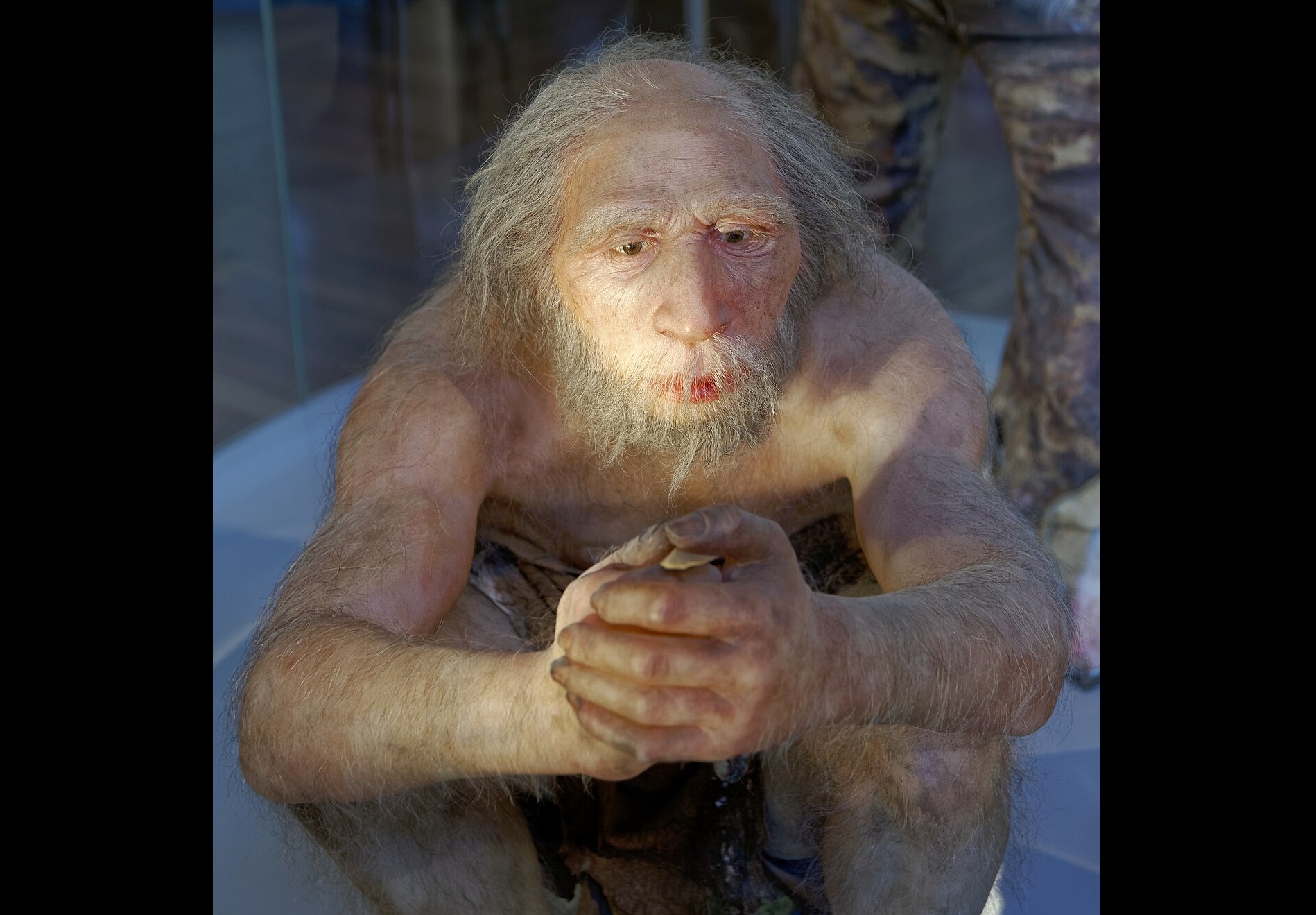
 Reconstruction of an elderly Neanderthal man at the Natural History Museum in Vienna.
Image Credit:
Jakub Hałun, CC BY-SA 4.0, via Wikimedia Commons
Ancient DNA Reveals How Two Population Expansions Shaped Neanderthal Ancestry Across Europe
Why do ancient European genomes show slightly more Neanderthal ancestry in the northwest than in the southeast? A new study suggests that the answer may lie largely in the direction of prehistoric population expansions rather than in natural selection alone.
The research examines how Neanderthal ancestry changed across Europe during two major demographic events: the spread of pre-Neolithic hunter-gatherers into the continent and, thousands of years later, the expansion of Neolithic farmers from western Anatolia and the Aegean.
Modern humans interbred with Neanderthals after leaving Africa and entering Eurasia. As a result, people outside sub-Saharan Africa today carry, on average, around 2% Neanderthal-derived DNA. Earlier research has shown that this ancestry is not evenly distributed across Europe. Instead, it forms a broad gradient, increasing from southeast to northwest.
To investigate how that pattern formed and survived later migrations, the researchers used a spatially explicit computer model that simulated interactions among three populations: Neanderthals, pre-Neolithic hunter-gatherers and Neolithic farmers. They compared the simulations with published ancient-DNA data from 715 European individuals, including 102 hunter-gatherers and 613 farmers.
The ancient genomes showed that pre-Neolithic hunter-gatherers carried an average of about 2.42% Neanderthal ancestry, compared with about 2.08% among Neolithic farmers. Despite this overall reduction, both groups retained a southeast-to-northwest gradient.
The simulations suggest that the first major expansion of modern hunter-gatherers into Europe helped create this pattern. As these populations moved mainly from the southeast toward the northwest and encountered Neanderthals, limited interbreeding generated a geographic gradient in Neanderthal ancestry. The model also indicates that the northern limit of stable Neanderthal occupation, probably around 50° to 55° north, helped shape the pattern.
Thousands of years later, farming populations expanded into Europe from the Aegean and western Anatolia along a broadly similar southeast-to-northwest axis. These farmers initially carried less Neanderthal ancestry than many European hunter-gatherers. Their arrival therefore reduced the average proportion of Neanderthal DNA in European populations through admixture and population replacement, while the direction of the older geographic gradient remained largely intact.
In other words, the Neolithic transition may have diluted Neanderthal ancestry without erasing its spatial pattern. As farmers mixed progressively with local hunter-gatherers, their own Neanderthal ancestry increased slightly over time, because hunter-gatherers generally carried more of it.
The findings also help clarify the role of natural selection. Neanderthal ancestry probably fell rapidly during the first generations after interbreeding as harmful genetic variants were removed. The new study does not challenge that early process. Instead, its simulations show that the later persistence and gradual changes of the European ancestry gradient can arise through migration, population expansion, genetic drift and admixture without requiring continuing natural selection as the main explanation.
The model also produced an estimate of strong reproductive isolation between Neanderthals and early modern humans. Fewer than 0.8% of simulated contacts between the two groups resulted in viable, fertile hybrid offspring under the best-fitting scenario. The authors stress, however, that not all demographic parameters could be estimated with equal confidence.
Several limitations remain. The simulations simplify a far more complicated population history, assume relatively constant demographic and migration parameters, and do not fully incorporate geographic barriers, multiple migration waves or regional differences. The Last Glacial Maximum, which occurred between the two population expansions studied here, was also not explicitly modeled. Some parameters, particularly the estimated rate at which hunter-gatherers were absorbed into farming populations, remain uncertain.
Even with these caveats, the study shows how geographic patterns preserved in ancient DNA can reveal movements that occurred tens of thousands of years ago. The Neanderthal ancestry carried by Europeans today and in the past may therefore record not only episodes of interbreeding, but also the routes taken by successive human populations as they spread across the continent.
Published on: 15-11-2026
Edited by: Abdulmnam Samakie
Source: Science Advances