- Archaeological News
-
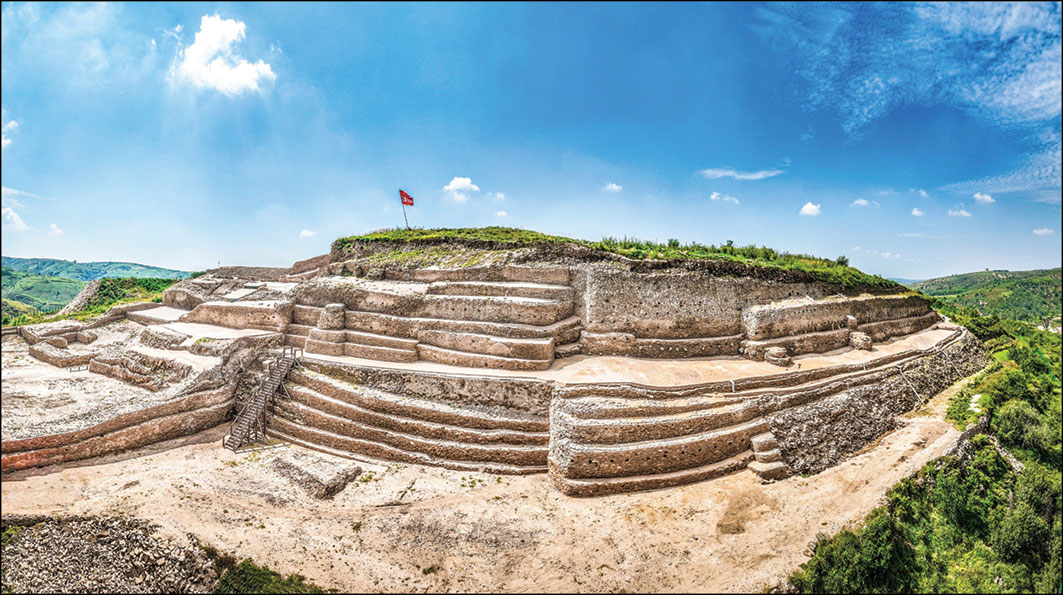
 The Imperial Terraces (Huangchengtai) at Shimao, China, where massive platforms of rammed loess were reinforced with stone-faced walls as part of the city’s monumental centre.
Image Credit:
Shaanxi Academy of Archaeology, reproduced in Rawson, Antiquity (2026)
Shimao’s Stone City Reshapes the Story of Early China
New archaeological publications on Shimao are bringing one of prehistoric China’s most unexpected cities into sharper focus, revealing massive fortifications, monumental terraces, elaborate gateways, ritual deposits and evidence of contacts reaching far beyond the Yellow River region.
Shimao flourished between about 2300 and 1800 BC on the northern edge of China’s Loess Plateau in present-day Shaanxi Province, roughly 700 kilometres north of Xi’an. When large-scale excavations began in 2012, archaeologists were surprised by the scale of what lay there. The settlement covers around four square kilometres and stands far north of the regions traditionally associated with China’s earliest major urban centres. Its discovery has helped transform views of how complex societies developed in northern China.
The city was protected by two enormous stone-faced defensive walls enclosing an Inner and Outer City. Together, their original courses extended for more than 10 kilometres, carefully adapted to cliffs, ridges and other natural features. Although Shimao initially appeared to be essentially a stone city, excavation has revealed a more sophisticated building tradition combining rammed loess with stone reinforcement.
At its centre stood the Huangchengtai, commonly called the Imperial Terraces. Eleven enormous platforms of compacted loess were constructed around a natural rocky core and faced with carefully laid stone. Archaeologists estimate that the upper terrace covered around eight hectares, while the entire monumental complex rose approximately 80 metres above the valley. Large timbers inserted into holes in the stone walls helped bind the outer facings to the loess platforms, demonstrating a carefully planned engineering system on a scale not previously known from the region.
Around this monumental centre lay residential areas. More than 70 dwellings have been identified, many of them small cave houses cut into loess, while others were subterranean or built above ground. They formed 11 clusters distributed between the Inner and Outer Cities, often close to cemeteries containing different burial traditions, including pit graves, stone-lined tombs and urn burials.
One of Shimao’s most striking structures is the East Gate, constructed around 2000 BC. Two large stone-faced towers of rammed earth created a narrow entrance, while additional walls forced anyone approaching to change direction as they entered. The resulting system of towers, barriers and controlled passageways has no known earlier parallel in China. The newly published research compares some of these features with fortifications farther west across Eurasia, proposing that certain ideas may have travelled over long-distance networks, although the evidence for the precise routes remains incomplete.
The gateway was more than a defensive installation. Six deposits of human skulls were placed beneath or around its foundations, apparently at different times, and their arrangement was connected with the solstice. Fine jade objects shaped like weapons or sceptres were also inserted into the walls. Together with pottery associated with feasting, these discoveries suggest that defence, ritual and elite display were closely intertwined at one of the city’s most important entrances.
Scientific analyses add another dimension to the story. Evidence indicates occupation before the great city emerged, including material associated with the late Yangshao culture around 2800 BC. The inhabitants relied heavily on millet and domesticated pigs, but cattle and sheep—animals originally domesticated in Western Asia—had reached the Loess Plateau by around 2500 BC. Their arrival may have helped support larger populations in this northern environment.
Stone arrowheads and spear points also indicate conflict or the threat of it. At the same time, imported ideas, livestock and later metal technologies reveal increasingly wide connections toward Inner Mongolia and north-western Eurasia.
Shimao therefore challenges an older picture in which the major developments leading toward early Chinese cities were centred mainly farther south on the Central Plains. Its walls, terraces, ritual practices and connections show that the northern Loess Plateau was not a distant margin. It was one of the places where new forms of urban life, engineering and long-distance interaction were already taking shape more than four thousand years ago.
Published on: 23-10-2026
Edited by: Abdulmnam Samakie
Source: Antiquity