- Archaeological News
-
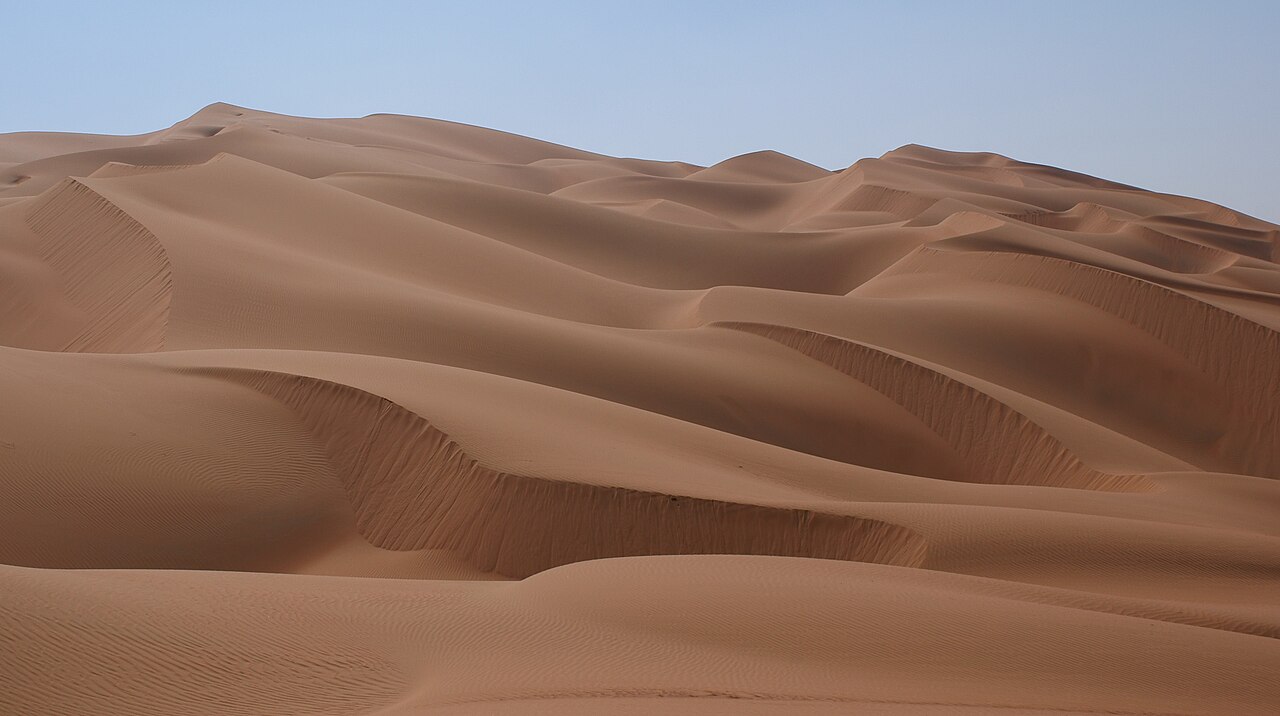
 Sand dunes of the Rub’ al Khali east of Liwa Oasis in Abu Dhabi, near the UAE–Saudi Arabia border.
Image Credit:
Nepenthes, CC BY-SA 3.0, via Wikimedia Commons
Stone Helped Decide Where Early Humans Could Live in Arabia
A vast survey across Arabia’s Empty Quarter suggests that freshwater alone didn’t determine where early humans could settle. Even when lakes dotted parts of the desert during wetter phases of the Pleistocene, people appear to have avoided large areas where they couldn’t obtain suitable stone for making tools.
The finding comes from an approximately 1,500-kilometre geoarchaeological survey across the central Rub’ al Khali, the world’s largest continuous sand sea. Researchers investigated 125 localities, including 55 places preserving evidence of ancient lakes, but found no stone tools, manufacturing debris or other traces of human occupation across the interior transect. Just as importantly, they found almost no suitable raw material from which such tools could have been made.
The result challenges a common assumption in models of prehistoric human movement across Arabia. During wetter climatic episodes, stronger monsoons transformed parts of the peninsula into landscapes containing lakes, wetlands and grasslands. These “Green Arabia” phases are often viewed as windows that allowed human populations to move through otherwise arid territory. Archaeological sites around the margins of the Rub’ al Khali confirm that people were present during several such periods.
The desert interior should therefore have appeared promising. Many of the ancient lake deposits surveyed correspond to a period between roughly 122,000 and 67,000 years ago, when human populations were already occupying areas around the Empty Quarter. Yet despite excellent ground visibility and widespread evidence for freshwater, the researchers found no archaeological material in the central basin.
The missing ingredient appears to have been stone. For populations dependent on stone tools, rocks such as chert, quartzite and other materials capable of producing sharp, predictable fractures were essential. In the central Rub’ al Khali, however, the geological formations exposed at the surface generally lack these materials. Across roughly 800 kilometres of the interior transect, the team found no suitable knappable stone, while the few occurrences were restricted to the western and eastern margins.
Evidence for the ancient lakes themselves was strong. Sediments contained freshwater molluscs, ostrich eggshell fragments and geological features associated with shallow lakes and later drying. The problem wasn’t simply that water had never existed there. Rather, the lakes often depended on groundwater, meaning rivers weren’t carrying useful stone into the basin from distant geological formations.
A broader spatial model produced the same pattern. Across the Arabian Peninsula, 57% of terrain considered accessible to water lies on geological formations lacking suitable stone for tool production. When raw-material availability was added to models based on water alone, the ability to distinguish known archaeological site locations improved substantially.
Comparisons elsewhere reinforce the argument. At Jubbah in northern Saudi Arabia, ancient lakes were accompanied by locally available quartzite, and Middle Palaeolithic populations repeatedly occupied the area. In parts of central Oman, the opposite situation occurs: good stone is abundant but freshwater is scarce, and archaeological sites are also uncommon. Together, these cases suggest that neither water nor stone alone was sufficient. Long-term settlement was most favourable where both occurred together.
People could transport stone over considerable distances, but that didn’t necessarily solve the problem. Archaeological studies elsewhere show that most stone used at long-term Palaeolithic sites usually came from nearby sources, while material transported over tens or hundreds of kilometres tended to represent only a small share of the toolkit. Supplying generations of residents more than 200 kilometres from dependable stone sources would have required a very different level of provisioning.
The researchers don’t rule out brief visits to the interior. Small camps or isolated traces may eventually be discovered. But the repeated absence of artefacts at 55 palaeolake localities suggests that any such activity was limited rather than evidence for sustained occupation.
The study therefore complicates the familiar image of “Green Arabia.” When wetter climates returned, not every lake became a place where people could live for long. The habitable landscape may instead have consisted of scattered zones where freshwater and workable stone overlapped. For early populations dependent on stone tools, geology could shape movement just as strongly as climate: water opened the desert, but stone helped determine where people stayed.
Published on: 30-10-2026
Edited by: Abdulmnam Samakie
Source: Nature