- Archaeological News
-
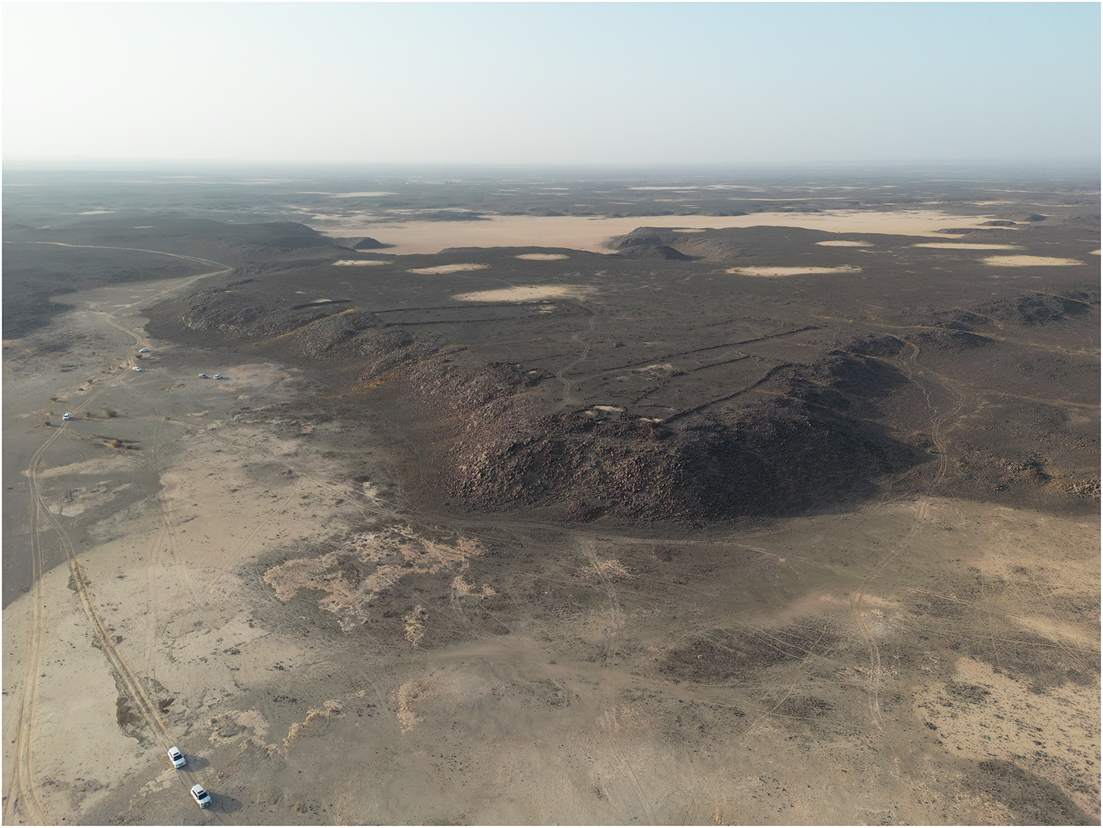
 Aerial view of the Al-Thamad study area in Harrat Khaybar, showing the basalt landscape and surrounding alluvial depressions that retain water after rainfall.
Image Credit:
Kennedy et al., PLOS One (2026)
Neolithic Mustatils of Khaybar Reveal a Shared Ritual Tradition Across Northern Arabia
Excavations among the monumental stone “mustatils” of Harrat Khaybar in northwestern Saudi Arabia have revealed new evidence for a widespread Neolithic ritual tradition centred on selected animal offerings, especially cattle. The work represents the first excavation of mustatils in Harrat Khaybar, where more than 400 of these structures are known, and allows direct comparison with previously investigated examples in AlUla.
Mustatils, named from the Arabic word for “rectangle,” are large stone-built monuments generally formed by a head platform and a base platform joined by long parallel walls around an open courtyard. More than 1,600 have now been identified across northern Arabia. Their scale, unusual architecture and deposits of carefully selected animal remains have led archaeologists to interpret them primarily as ritual rather than domestic structures.
The new fieldwork focused on a concentration of 28 mustatils about 7.5 kilometres southeast of Al-Thamad, within the volcanic landscape of Harrat Khaybar. All 28 structures were surveyed, while test excavations were carried out in three. The monuments stand mainly on basalt plateaus overlooking alluvial depressions that retain water after rainfall, placing them close to resources that would have been valuable for pastoral communities.
One of the most striking findings is the architectural diversity of the Khaybar monuments. Four variants were recorded, although the basic mustatil form remained recognizable. Some followed the familiar rectangular layout, while others incorporated rows of stone pillars, oval chambers or crescent-shaped bases. One especially elaborate structure contained narrow tunnels less than a metre high and wide in front of its entrance. Anyone entering would have had to crawl through these passages before reaching the interior. The purpose of this arrangement remains uncertain, although it shows that access could be carefully structured and physically demanding.
Despite these architectural differences, the deposits inside the monuments were remarkably consistent. Across the excavated and sampled structures, animal remains were dominated by horned ruminants, particularly domestic cattle. Most identifiable remains came from the upper parts of skulls, especially teeth and cranial elements, while lower jaws were notably absent. This selective pattern differs from ordinary food refuse and closely resembles deposits already known from mustatils in AlUla.
A total of 681 animal remains were collected from ten mustatils, including 638 from the three excavated structures. Preservation was generally poor, but cattle formed the largest identifiable group. In one excavated chamber, remains represented at least five cattle within a relatively small area, suggesting that offerings had been densely deposited. Small ruminants were also present, showing that ritual activity was not restricted exclusively to cattle.
Radiocarbon dating places most of the investigated Al-Thamad mustatils within the fifth millennium BC. One excavated structure produced a date of about 4796–4620 BC, another contained two phases of offerings dating approximately to 4696–4539 BC and 4537–4365 BC, while a third dated to around 4709–4547 BC. A much later surface sample from another monument falls in the early fourth millennium BC and may represent a later dedication or reuse after the main period of mustatil activity.
These dates are important because the Khaybar examples generally appear later than the earliest known mustatils in AlUla. When the two regions are considered together, the main tradition may have lasted close to a millennium, broadly between about 5300 and 4400 BC. The current evidence raises the possibility that the tradition emerged farther northwest before spreading into Harrat Khaybar, although the limited number of excavated monuments means its precise origin remains unresolved.
The similarities between Khaybar and AlUla are especially significant. In both regions, monumental rectangular spaces were associated with deliberate deposits of selected parts of horned animals, particularly cattle. This combination of architecture and repeated ritual behaviour suggests that mustatils may have expressed a shared ceremonial concept across a very large area of northern Arabia.
At the same time, the findings show that this tradition was not architecturally rigid. Communities at Khaybar adapted monument design to local materials, landscapes and perhaps different ways of organizing access and participation, while maintaining broadly similar offering practices. The mustatils therefore offer evidence not only for early monumental construction, but also for the transmission of ritual ideas among mobile pastoral communities thousands of years before the rise of the region’s later urban societies.
Published on: 22-09-2026
Edited by: Abdulmnam Samakie
Source: PLOS One