- Archaeological News
-
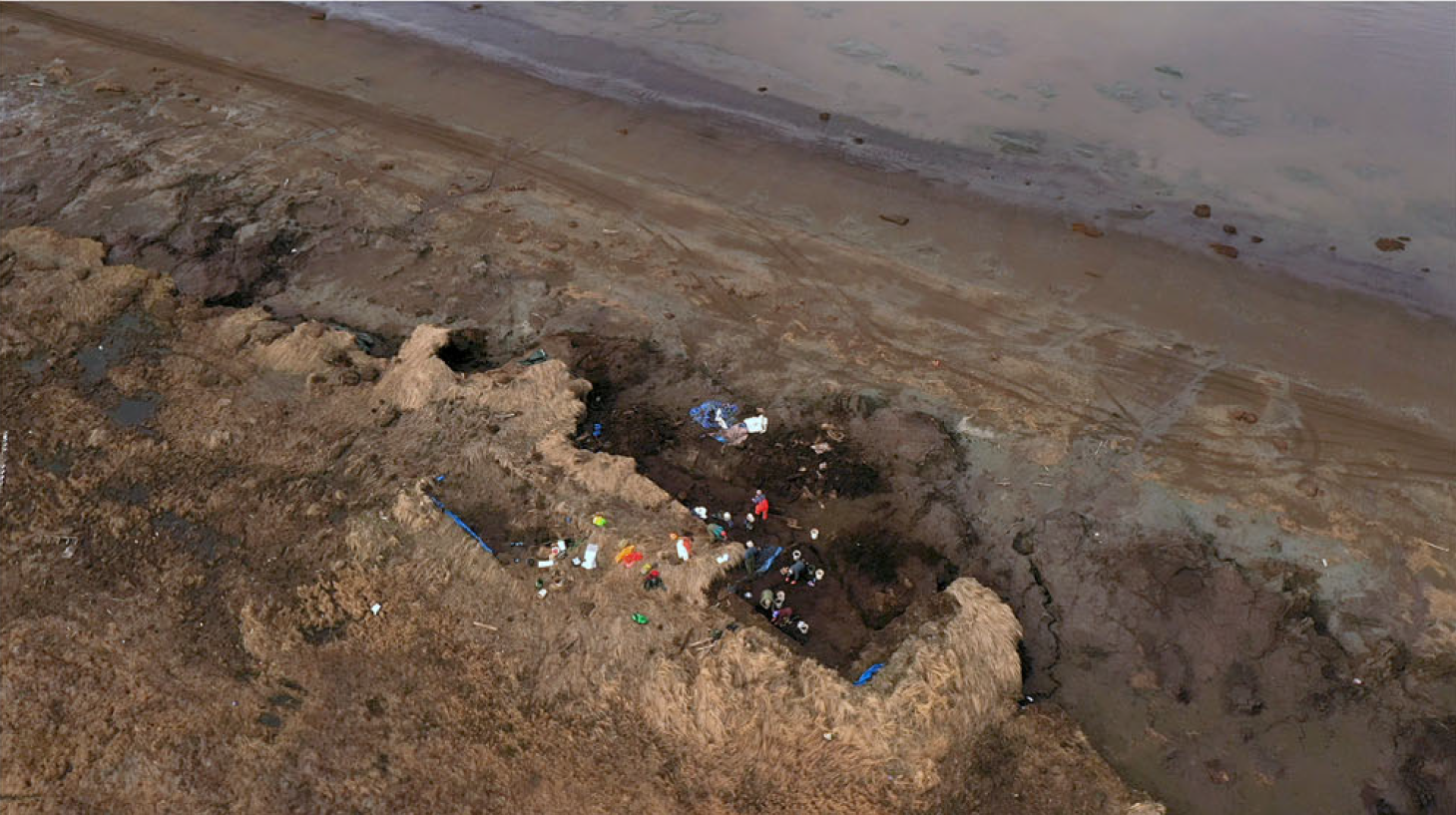
 Post-typhoon coastal erosion at the Nunalleq archaeological site in Alaska.
Image Credit:
Alice Watterson, in Hillerdal, Communications Earth & Environment (2026)
As Alaska’s Coast Erodes, Archaeology Helps Preserve Yup’ik Heritage
Rapid coastal erosion and thawing permafrost are threatening archaeological sites and living cultural traditions in Alaska, while a long-running community archaeology project at Nunalleq shows how heritage work can help strengthen connections between Indigenous communities and their past. The case highlights an increasingly urgent challenge in the Arctic, where climate change is damaging ancestral landscapes at the same time that local communities are working to preserve cultural knowledge and identity.
The Yup’ik homeland in southwestern Alaska lies across the Yukon-Kuskokwim Delta, a low-lying wetland along the Bering Sea. The region is particularly vulnerable to sea-ice loss, rising sea levels, storm flooding, erosion and permafrost thaw. These processes threaten villages, infrastructure, traditional subsistence areas and archaeological sites. Across Alaska more broadly, 144 of 200 Native communities have been identified as facing some degree of infrastructure damage from erosion, flooding, permafrost degradation or a combination of these hazards, with 27 considered severely threatened.
One of the clearest examples is Nunalleq, an ancestral Yup’ik settlement near the present-day village of Quinhagak. The site was occupied between about AD 1570 and 1675. In 2009, growing coastal erosion prompted the local community to partner with archaeologists to investigate the site before more of it disappeared into the sea. Local Elders gave it the name Nunalleq, meaning “Old Village.”
Excavations revealed exceptionally well-preserved organic remains and a collection now approaching 200,000 artifacts. Finds include parts of kayaks and sleds, hunting and fishing equipment, household objects, personal ornaments, items connected with craftwork and play, and ceremonial objects. Fragile materials such as woven grass and baleen also survived. Together, the finds provide an unusually detailed picture of Yup’ik life before sustained colonial contact and document how communities adapted during the climatic cooling associated with the Little Ice Age.
The project has also become closely connected with the descendant community. Archaeological work was developed through collaboration with local residents, with community priorities helping to shape research questions and public interpretation. A local culture and archaeology center, established in 2018, now houses the collection. The artifacts have also helped younger residents engage with ancestral practices and with a history that remains closely connected to present-day fishing, hunting, gathering and craft traditions.
At the same time, the physical site has continued to deteriorate rapidly. By the summer of 2024, at least 10 to 15 metres of coastline had been lost since excavations began, and the areas excavated in 2009 and 2010 had disappeared. Changes below the surface were equally striking. During the first excavation seasons, permafrost was encountered about 50 centimetres below ground. By 2018, archaeologists reached about 1.5 metres without encountering it, illustrating the scale of thaw at the site.
The threat intensified in October 2025, when Typhoon Halong removed another approximately 20 metres of coastal tundra. Erosion reached previously unexcavated areas that had been considered protected behind an already excavated strip of coastline. The storm also affected Yup’ik communities across the delta, damaging homes and infrastructure and forcing around 1,500 people to evacuate.
Yet Nunalleq also demonstrates that archaeological preservation is not limited to keeping a site physically intact. After the storm, local residents recovered hundreds of exposed artifacts from the beach and brought them to the community museum. Although parts of the archaeological landscape may ultimately be lost, documentation, collections, local knowledge and community participation can preserve connections to that landscape in other forms.
The wider lesson is that community-based archaeology can contribute to cultural resilience when archaeological work is carried out with, rather than simply about, descendant communities. In the Arctic, where environmental change is accelerating, heritage projects can document threatened sites while also supporting the transmission of knowledge, strengthening a sense of continuity and ensuring that local perspectives remain central to decisions about what should be studied, preserved and remembered.
Published on: 08-09-2026
Edited by: Abdulmnam Samakie