- Archaeological News
-
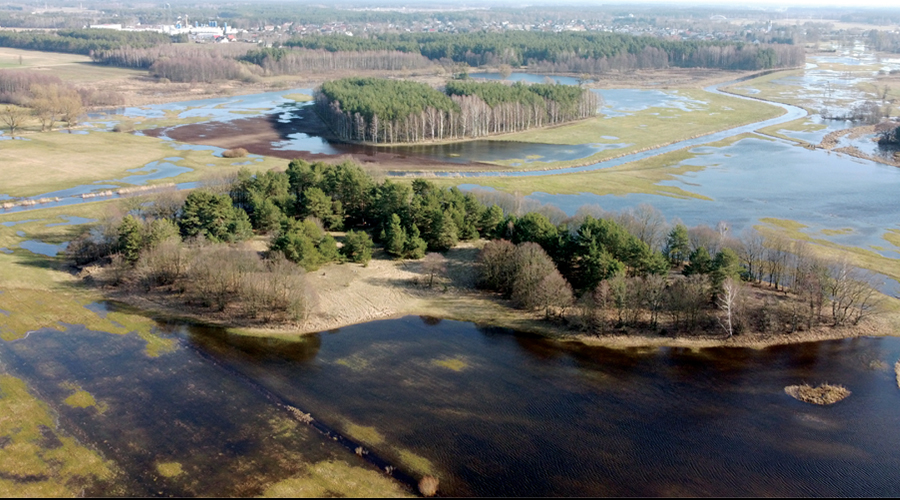
 View of Łysa Góra in north-eastern Poland, a fortified Early Iron Age settlement situated on a natural elevation surrounded by wetlands.
Image Credit:
T. Rakowski, in Kaczyński et al., Antiquity (2026)
Bronze Helmet and Amber Finds Reveal an Iron Age Trade Hub in Poland
New excavations at Łysa Góra in north-eastern Poland are transforming the understanding of a little-known Early Iron Age settlement, revealing a fortified community that combined craft production, ritual activity and long-distance exchange along what researchers identify as a northern branch of the ancient Amber Route.
The site lies on a glacial sand dune between the Orzyc River and an oxbow lake near Bagienice in northern Mazovia. During the sixth to fourth centuries BC, it was occupied by communities of the West Balt Barrow Culture, whose fortified settlements, aquatic subsistence strategies and collective urn burials distinguished them from many contemporary societies elsewhere in Central Europe. For that reason, the discovery of numerous objects connected with the La Tène cultural world farther south came as a surprise.
Łysa Góra had been known since 1957 and was excavated intermittently between the 1970s and early 1990s, but much of the material was never comprehensively analysed or published. Investigations resumed in 2024, and the results quickly changed the picture. Nearly 350 metal objects were recovered, including ornaments and weapons, together with evidence for bronze working, large quantities of pottery, animal bones, cereal grains, cultivated plant remains and charred wood.
The settlement was naturally well protected by the surrounding marshland, but its inhabitants strengthened the position further. Excavations uncovered two different defensive systems dating to around the middle of the first millennium BC. One consisted of an earthen rampart topped by a palisade and accompanied by an external ditch reinforced with wooden elements; another, identified farther north, appears to have been constructed entirely from timber. Whether the two fortifications functioned at the same time remains unclear.
Evidence from inside the settlement suggests that trade and production were central to life there. Archaeologists found broken bronze ornaments bundled together, probably ready to be melted down and reused, while earlier excavations had already uncovered ceramic crucibles associated with metalworking. Amber provides another important clue: beads and an unfinished amber ring indicate that the community wasn’t simply receiving finished objects, but may have participated more directly in the handling and circulation of this highly valued Baltic material.
Ritual activity also formed part of the settlement’s landscape. In marshy ground below the south-western slope, researchers identified deposits containing bronze rings and earrings decorated with glass beads. One included an elaborately ornamented spiral bronze armlet that had been repaired during its period of use.
The most striking discovery, however, came from within the fortified area: a Berru-type bronze helmet of La Tène origin, deliberately crushed and fragmented before being placed in a pit with charred material, a scythe and several iron adzes. Comparable helmets are known from sites such as Dürrnberg in Austria, far to the south. Łysa Góra also produced 31 mostly fragmentary Early La Tène brooches and ring ornaments dating to around the middle of the fourth century BC.
That helmet may carry significance beyond trade alone. In the La Tène world, such objects were associated with high status and warrior elites, a social concept that may have differed sharply from the organisation of local communities in north-eastern Poland. Researchers therefore consider the possibility that people from southern La Tène regions—including members of an elite group—were physically present at Łysa Góra. Indirect exchange can’t be excluded, but the prestige and rarity of the helmet make that explanation less convincing.
The site’s location strengthens the wider interpretation. Łysa Góra lies close to the amber-rich Kurpie region and routes leading toward the Sambian Peninsula, placing it in an advantageous position for controlling or facilitating the movement of amber toward Central Europe. The finds may therefore reflect direct involvement by La Tène communities in organising or maintaining part of this long-distance exchange network, although the researchers stress that this remains a hypothesis requiring further testing.
Łysa Góra now emerges as much more than an isolated fortified settlement. It appears to have served simultaneously as a defensive centre, production site, ritual place and likely hub in the amber trade, connecting culturally distinct communities across a surprisingly large part of Iron Age Europe. Future non-invasive surveys, metallurgical studies and isotope analyses may show just how far those connections reached.
Published on: 15-10-2026
Edited by: Abdulmnam Samakie
Source: Antiquity