- Archaeological News
-
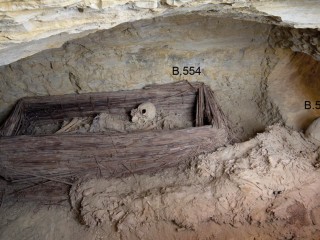 Burial B.554 at Saqqara West, showing human remains preserved inside a reed coffin within the rock-cut burial chamber.
Image Credit:
Kozieradzka-Ogunmakin & Woźniak, Frontiers in Environmental Archaeology (2026)
Burial B.554 at Saqqara West, showing human remains preserved inside a reed coffin within the rock-cut burial chamber.
Image Credit:
Kozieradzka-Ogunmakin & Woźniak, Frontiers in Environmental Archaeology (2026)
Rain Beneath Saqqara: Ancient Linen Reveals Hidden Burial Microclimates
A new study of late Old Kingdom burials at Saqqara West in Egypt shows that the survival of ancient linen textiles depended not simply on the region’s dry climate, but on the specific microenvironment created inside each tomb. By comparing human remains, coffin materials, burial architecture, sediments and surviving fabrics, researchers found that small differences in water infiltration and drainage could determine whether linen survived for more than four millennia or disappeared almost completely.
The investigation focused on five burials dating to the late Old Kingdom and early First Intermediate Period, between about 2498 and 2160 BC. These burials belong to the Lower Necropolis at Saqqara West, immediately west of the Step Pyramid of Djoser. The dead were generally placed in underground rock-cut chambers reached through vertical shafts and laid inside reed or wooden coffins. Linen was used as clothing, body wrapping and funerary material.
Despite broadly similar burial customs and chronology, textile preservation varied dramatically. In three burials, large fragments of linen survived in very good condition, some still retaining flexibility and recognizable garment features such as sleeves, hems and fringed borders. In two other graves, no textile itself remained. Instead, only impressions of woven fabric survived in hardened mud inside the coffins, showing that linen had originally been present but later decomposed. The bones told a different story. Skeletal remains from all five individuals were generally well to exceptionally preserved, with little or no surface cracking, flaking or weathering. This contrast is important because it shows that good bone preservation does not necessarily mean that all organic materials experienced equally stable conditions. Linen, made largely of cellulose, is more vulnerable to moisture and microbial activity than mineralized bone and therefore provides a more sensitive record of changes within the burial environment.
The environmental explanation is closely connected with the geology of Saqqara West. The cemetery was established on a gently sloping limestone terrace, and archaeological evidence shows that some underground tombs experienced episodes of rainwater infiltration and sediment accumulation. These local rainfall events occurred during a broader period of increasing aridity around 2200 BC. The two patterns are not necessarily contradictory: even within a generally drying climate, occasional heavy rains could still generate runoff and temporarily flood underground structures.
Once water entered a shaft tomb, its effect depended on where it accumulated and how quickly it could escape. The study suggests that tomb architecture, the low permeability of the limestone and the material used for coffins all contributed to the resulting microenvironment. Reed coffins may have allowed infiltrating water to drain more readily, while wooden coffins may have retained moisture for longer. This interpretation remains provisional, but it fits the observed preservation pattern: the best-preserved textiles came from burials with reed coffins, whereas two wooden-coffin burials preserved only textile impressions.
Those impressions provide unusually valuable evidence. In one child burial, the dried sediment preserved the negative pattern of a woven linen textile. In another burial, several impressions revealed traces of three or four different fabrics, including relatively fine textiles. Their survival demonstrates that the garments or wrappings were once present even though the fibres themselves had decayed.
The study also points to possible human responses to these environmental pressures. Later changes in tomb design at Saqqara West included lowering parts of the shaft floor to improve drainage and reduce the accumulation of rainwater and sediment. Such modifications suggest that ancient builders were aware of water-related problems and adapted burial architecture accordingly.
Important questions remain unresolved. Chemical analyses of selected textile samples were still pending when the study was published, meaning that possible embalming substances, fibre degradation processes and some causes of discoloration have not yet been confirmed. The study therefore treats several interpretations cautiously.
Even so, the results show that the exceptional preservation associated with ancient Egypt was not uniform. Within the same cemetery, small differences in tomb position, construction, coffin material and exposure to water created distinct burial environments. Ancient linen, including fabrics that survive only as impressions in dried mud, can therefore provide evidence not only about clothing and funerary practice, but also about local environmental change and the practical challenges faced by communities burying their dead more than four thousand years ago.
Published on: 26-09-2026
Edited by: Abdulmnam Samakie
