- Archaeological News
-
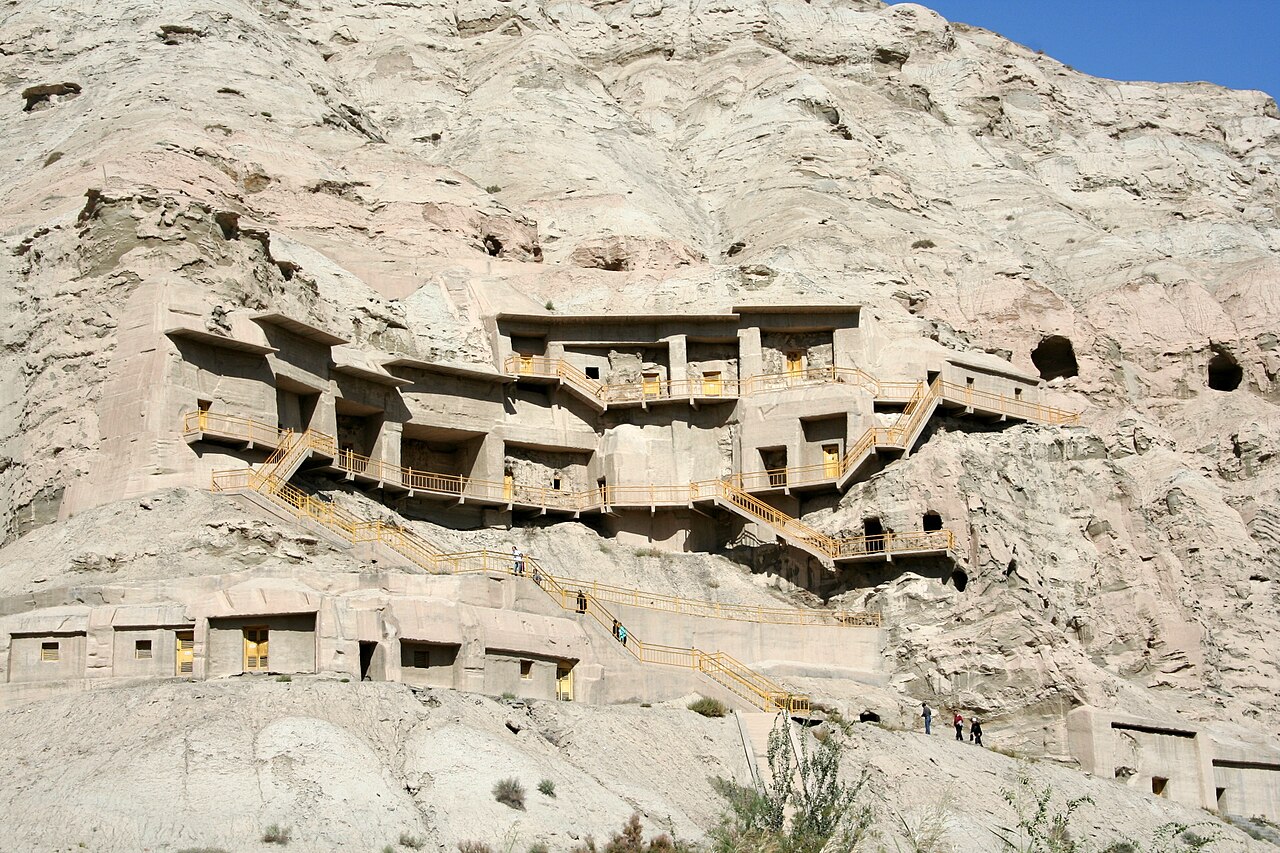
 Kizil Caves of the Thousand Buddhas, Xinjiang, China
Image Credit:
Rolfmueller, CC BY-SA 3., via Wikimedia Commons
Kizil Caves of the Thousand Buddhas, Xinjiang, China
Image Credit:
Rolfmueller, CC BY-SA 3., via Wikimedia Commons
Salt Weathering Threatens the Kizil Grottoes Along the Silk Road
A new heritage study has identified how salts, moisture and the internal pore structure of surrounding rocks interact to damage the Kizil Grottoes in Xinjiang, China, one of the major Buddhist cave complexes along the ancient Silk Road.
The grottoes were carved into the cliffs of Mingwu Tagh Mountain near the Muzat River, in an arid environment characterized by low rainfall, strong evaporation and large temperature fluctuations. Such conditions encourage soluble salts to move through cracks and pores before crystallizing inside or on the surface of the rock.
Repeated cycles of salt dissolution and crystallization can generate pressure strong enough to detach particles, create microcracks and eventually cause sections of the rock to break away. The process also threatens decorated cave interiors through flaking and hollowing.
Field observations identified two main patterns of deterioration.
Caves farther from springs generally showed shallow surface damage, including salt deposits, pulverization, honeycomb weathering and granular breakdown. The affected zone was typically less than five millimetres deep. Researchers link this pattern mainly to rapid evaporation and repeated cycles of salt crystallization near the surface.
Conditions were different near springs and seepage zones. Here, persistent water supplied salts deeper into the rock through capillary movement. Damage extended farther below the surface and included basal erosion and thick layers of rock breaking away. The researchers describe this as an “inside-out” deterioration process that may result from the combined action of salt crystallization and the swelling and shrinking of clay minerals.
To investigate these processes, the team collected 18 samples representing three major rock types: mudstone, sandstone and argillaceous fine sandstone. The samples were taken from different locations along a gradient influenced by Qianlei Spring.
Laboratory analyses examined mineral composition, soluble salts, pore structure and microscopic deterioration. Instead of assessing these factors separately, researchers combined three measurements into a new diagnostic framework.
The first represents the sensitivity of clay minerals to moisture. The second measures the total amount of soluble salts. The third evaluates how the size and connectivity of pores influence salt uptake and crystallization.
The resulting system distinguishes rocks primarily sensitive to salt load, pore structure or clay-related moisture, as well as samples affected by combinations of these processes. The study found that apparently similar forms of deterioration can therefore develop through different mechanisms.
This distinction has important implications for conservation. Areas dominated by vulnerable pore structures may require strengthening materials that remain permeable rather than treatments that block pores. Where salt accumulation dominates, priorities include controlling seepage, improving drainage and carefully removing soluble salts.
Rock particularly sensitive to clay and moisture requires greater control of water supply and fluctuations in humidity. Areas affected by several factors may need combined treatments rather than a single conservation method.
The researchers caution that the framework is intended as a comparative diagnostic tool rather than a system for predicting exactly how quickly deterioration will occur. Nevertheless, it offers a way to identify why different parts of the Kizil Grottoes are deteriorating and to design conservation measures according to the specific processes affecting each area.
The approach could also be applied to other sandstone grottoes where similar mineral, salt and pore-structure data are available, potentially supporting more targeted protection of vulnerable rock-cut heritage sites along the Silk Road.
Published on: 08-08-2026
Edited by: Abdulmnam Samakie
Source: npj Heritage Science