- Archaeological News
-
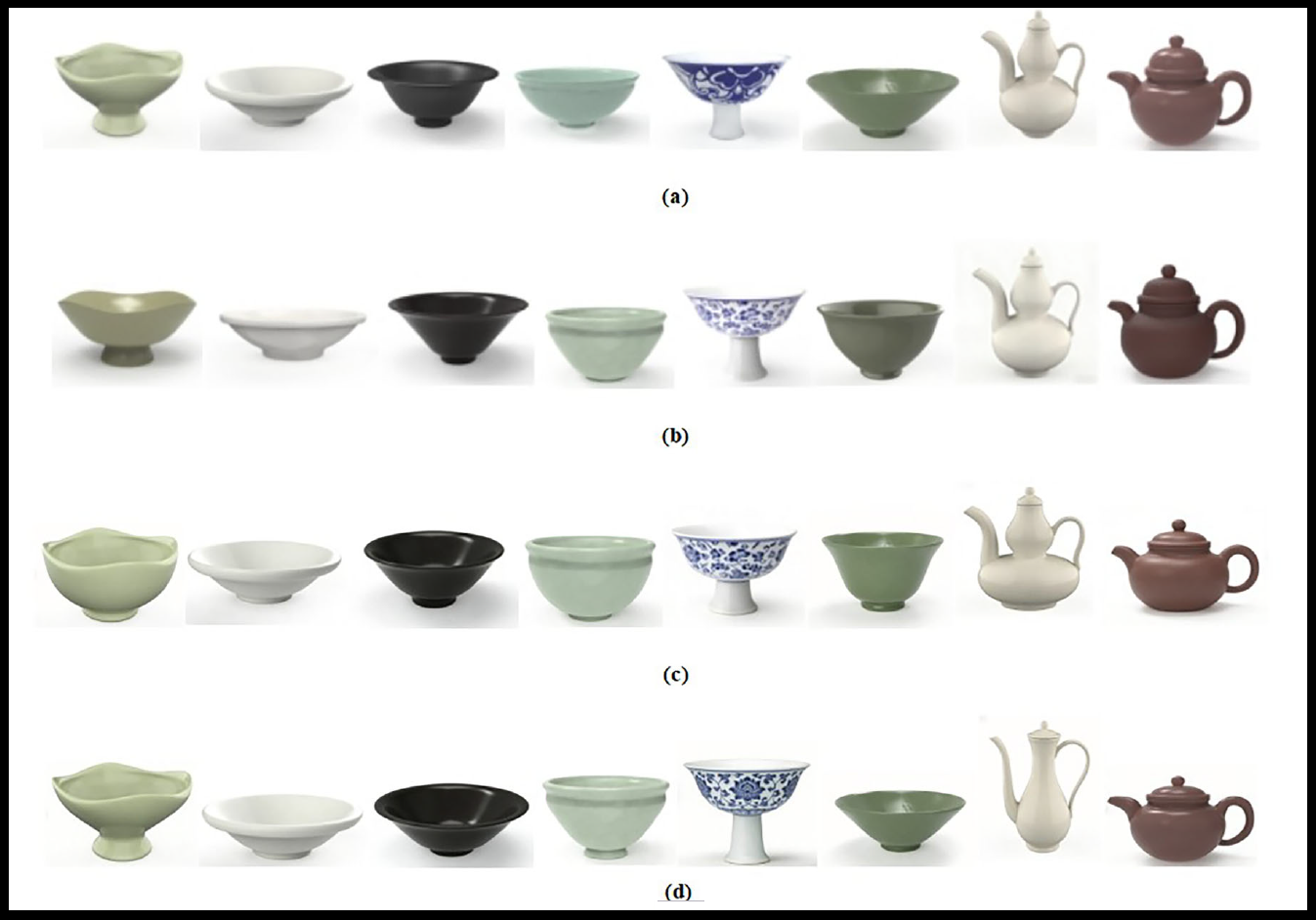
 Comparison of Chinese teaware styles from eight kiln traditions: manually modelled examples (a), TPGC-IGA-generated models (b), standard IGA models (c), and StyleGAN-generated models (d).
Image Credit:
Yang et al., npj Heritage Science (2026)
Comparison of Chinese teaware styles from eight kiln traditions: manually modelled examples (a), TPGC-IGA-generated models (b), standard IGA models (c), and StyleGAN-generated models (d).
Image Credit:
Yang et al., npj Heritage Science (2026)
Digital “Genes” Recreate Centuries of Chinese Teaware Styles
A new digital heritage system is using a process inspired by biological evolution to reproduce and combine the distinctive styles of historic Chinese teaware. Drawing on hundreds of surviving objects from eight major kiln traditions, the approach converts features such as vessel shape, glaze and decoration into controllable digital “genes,” allowing researchers to generate three-dimensional models while keeping their stylistic development traceable.
Chinese teaware changed considerably between the Tang and Qing dynasties as regional workshops developed distinctive technologies, materials and aesthetic traditions. Yue celadon, Jian black-glazed bowls, Jingdezhen porcelain and Yixing purple-clay teapots, for example, can often be distinguished through characteristic combinations of form, surface treatment and decoration. These differences also reflect changing tea-drinking practices and artistic preferences over many centuries.
To capture this diversity, the researchers assembled a database of 420 well-dated and dimensionally documented objects from eight kiln traditions: Yue, Xing, Jian, Longquan, Ding, Yaozhou, Jingdezhen and Yixing. The collection contains 281 tea bowls and 139 ewers, with material drawn from museum collections, publications and other documented sources. Each object was analysed through three main dimensions: shape, glaze colour and material, and decoration.
The system then breaks vessel shapes into individual components that can be expressed mathematically. A tea bowl, for example, can be defined through features including its rim, body and foot, while an ewer is divided into components such as the mouth, spout, body, lid, handle and base. Dimensions and curves can then be modified within ranges derived from historical examples.
The most distinctive element is a three-level coding structure resembling a genetic hierarchy. At the highest level, an “era gene” establishes the historical period and restricts the range of acceptable proportions. A second layer identifies kiln traditions, including characteristic forms and glaze materials. The lowest level contains parameter genes controlling the detailed geometry of the vessel. The arrangement is designed so that lower-level features cannot freely contradict the broader historical and stylistic rules established above them.
Instead of producing a single predetermined model, the interactive genetic algorithm generates populations of possible designs. Users score the results, and better-rated examples are selected as “parents.” Their digital genes are then recombined and occasionally mutated to generate a new population. At the same time, the system evaluates geometric proportions and whether the resulting vessel remains consistent with the cultural constraints assigned to its period and kiln tradition.
The researchers tested both the reproduction of individual kiln styles and the more experimental combination of traditions from different kilns and historical periods. Eight professional ceramic designers and five senior specialists in ancient ceramic appraisal participated in modelling and blind evaluation.
In three cross-kiln test cases, expert scores for the accuracy of stylistic integration averaged 6.53, while aesthetic quality averaged 7.11. Historical consistency averaged 6.07 but did not show a statistically significant improvement over the comparison level. This distinction is important: while the generated objects were rated positively for their appearance and their combination of recognizable kiln features, their historical credibility remains more difficult to demonstrate quantitatively.
Some generated forms nevertheless showed strong geometric similarity to documented museum pieces. One experimental design combining characteristics associated with Jian and Jingdezhen traditions reached an average shape similarity of 89 percent with selected reference objects. Other cases reached 86 and 88 percent. These experiments are intended to explore how stylistic characteristics might be combined under explicit rules rather than to claim that the generated vessels reproduce actual lost artifacts.
The method also has limitations. The database currently represents only eight major kiln traditions, while many regional workshops are absent. Decorative elements such as carving, stamping and painted ornament remain less developed than the modelling of shape and glaze. Cultural factors that cannot easily be reduced to measurements—including changing tea customs and scholarly tastes—are also difficult to encode.
The system therefore represents an experimental tool for digital heritage rather than a reconstruction of historical manufacturing itself. Its main contribution is to make stylistic relationships computationally explicit, allowing researchers to explore ceramic forms while seeing which historical, technological and aesthetic parameters produced each digital result.
Published on: 18-09-2026
Edited by: Abdulmnam Samakie
Source: npj Heritage Science