- Archaeological News
-
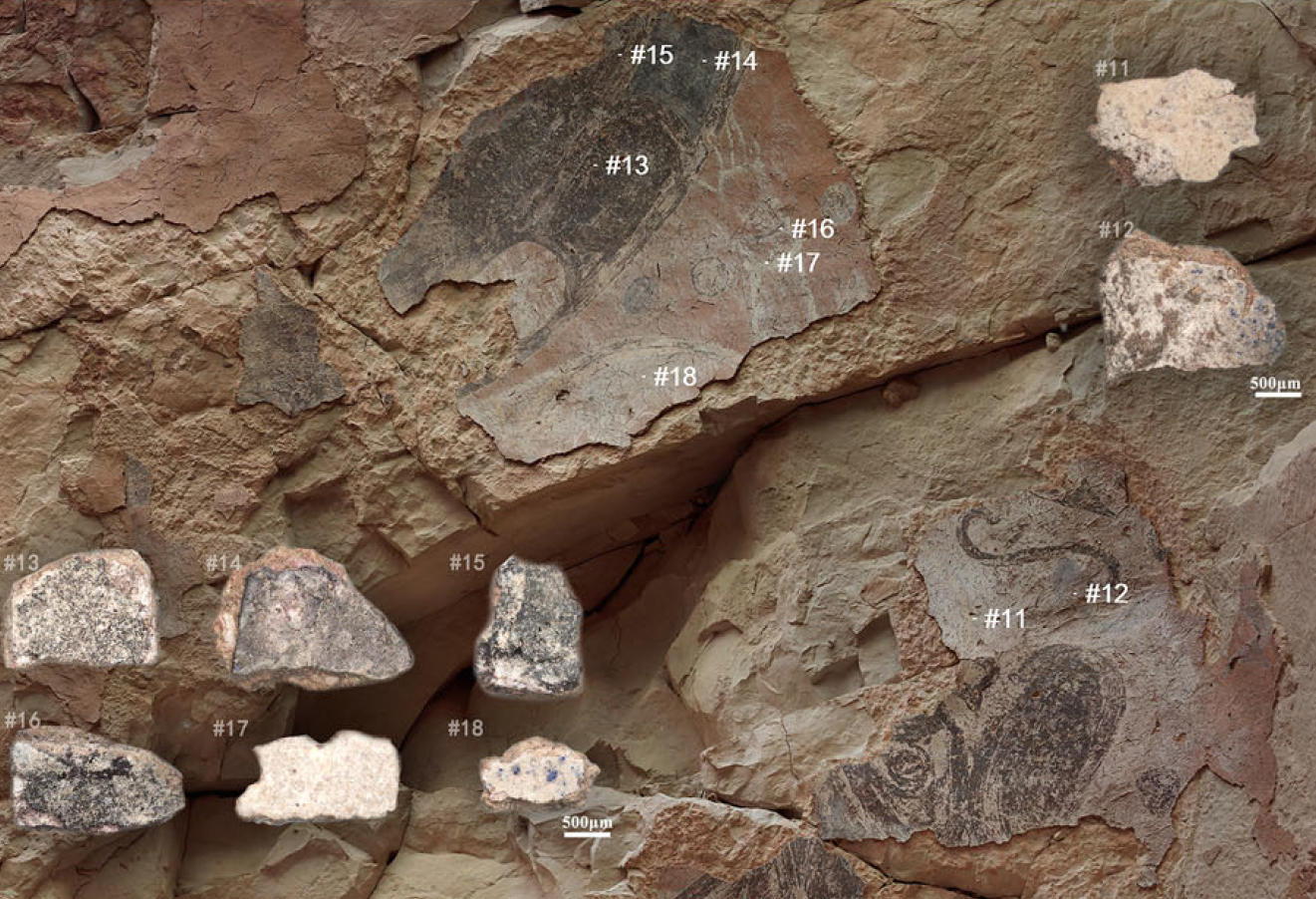
 Ceiling of the main chamber in Kizil Giant Buddha Cave No. 47, showing surviving wall paintings and pigment sampling areas.
Image Credit:
Zhou et al., npj Heritage Science (2026)
Ancient Pigments Reveal Lost Colors and Fire Damage in Kizil’s Giant Buddha Cave
Scientific analysis of surviving wall paintings in Cave No. 47 at the Kizil Grottoes in Xinjiang, China, has revealed how ancient artists prepared their surfaces, selected pigments and adapted their methods to different parts of one of the Silk Road’s most important Buddhist cave monuments. The results also show that some colors visible today are not original at all, but products of centuries of chemical alteration, environmental exposure and past fire.
The Kizil Grottoes, on the northern edge of the Tarim Basin, contain 369 caves and form part of the UNESCO-listed Silk Roads: Routes Network of Chang’an-Tianshan Corridor. Cave No. 47 is the largest and most representative of Kizil’s Giant Buddha caves. Dating to the 4th century AD and rising to about 16.7 metres, it is widely regarded as the earliest surviving large-scale Giant Buddha cave in the world. Its central chamber originally contained a monumental Buddha image supported by a wooden framework.
Close examination of the paintings was difficult because much of the upper chamber lies high above the floor and has suffered extensive flaking and loss. Using scaffolding, researchers documented the surviving surfaces, examined them microscopically and analyzed tiny samples from damaged edges. The investigation identified three painting approaches: pigments applied directly to prepared rock, painting over a single plaster layer, and more complex multilayered systems combining plaster, a white ground and a final pigment layer.
The plaster itself was not applied uniformly. On parts of the vaulted ceiling it was relatively thin, reducing weight and the risk of detachment, while wall surfaces received thicker preparation layers that created a flatter base for detailed painting. Plant fibers, including straw, were mixed into some earthen plaster, and wooden pegs were inserted into irregular or fractured rock to help anchor thicker layers. Evidence of repainting was also found, including places where later white or red-painted layers covered earlier painted surfaces.
Pigment analysis revealed that red areas were mainly associated with iron-rich hematite, while the surviving blue particles were identified as high-purity lazurite, the mineral responsible for ultramarine. The purity of the blue material suggests careful processing before use. Green areas contained copper-based compounds, with paratacamite identified as the principal surviving green mineral. Arsenic was also found in these zones, suggesting that the artists may originally have applied an arsenic-bearing yellow layer beneath the green pigment.
One of the most striking findings concerns the blackened areas. Many were not painted black originally. Several contain plattnerite, a dark degradation product formed from lead-based pigments, while others contain tenorite, a black copper oxide. Tenorite had not previously been documented in Kizil wall paintings. Its presence is especially significant because the cave preserves visible traces of burning, including reddened plaster, charcoal and partly charred wooden remains. The copper oxide was therefore likely produced when earlier copper-based green or blue pigments were altered by high temperatures.
The cave’s unusual light-yellow areas also appear to be products of deterioration rather than intentional yellow paint. Their present color results from layers containing altered lead compounds mixed with gypsum or anhydrite. Likewise, abundant anhydrite in the ceiling preparation may have formed when original gypsum was dehydrated by heat during earlier fire events, although naturally occurring gypsum may also have contributed to the mineral composition.
Environmental exposure continued the transformation after the fires. Unlike many cave paintings protected inside enclosed chambers, much of Cave No. 47 has long been exposed to open-air conditions, including strong sunlight, daily temperature changes and fluctuating humidity. These factors contributed to pigment alteration, surface loss and continuing chemical reactions.
The findings provide a clearer picture of both the sophistication and vulnerability of the paintings. Ancient artisans adjusted plaster thickness, supports and pigment layering to suit different surfaces and colors, while later fires and prolonged exposure transformed much of what survives today. Understanding which colors are original and which are products of degradation is therefore essential for future conservation and for reconstructing the appearance of this early Buddhist monument.
Published on: 07-09-2026
Edited by: Abdulmnam Samakie
Source: npj Heritage Science