- Archaeological News
-
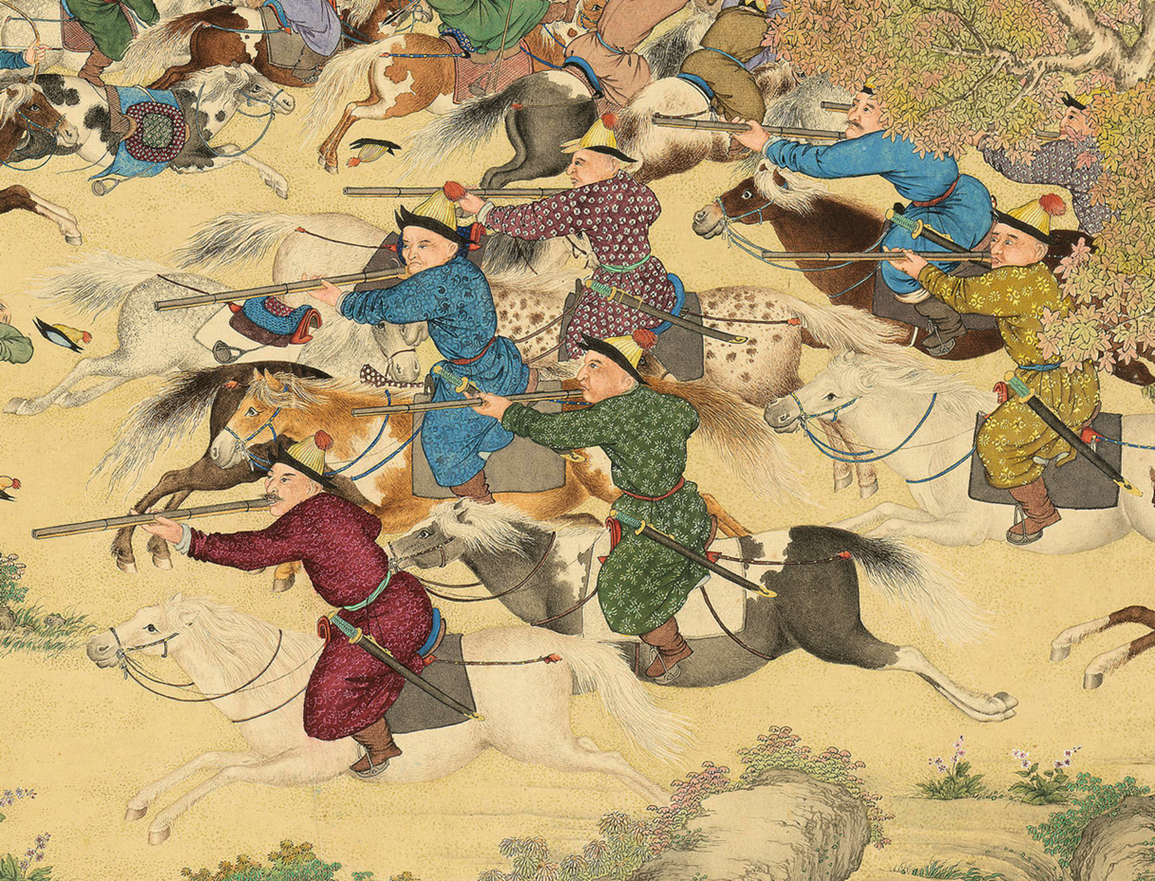
 Dzungar cavalry of Amursana, last of the Dzungar rulers, in the Battle of Khorgos against Qing China (1758)
Image Credit:
Public domain, via Wikimedia Commons
Dzungar cavalry of Amursana, last of the Dzungar rulers, in the Battle of Khorgos against Qing China (1758)
Image Credit:
Public domain, via Wikimedia Commons
Climate Crisis and Smallpox Brought Down Eurasia’s Last Nomadic Empire
A new study suggests that an exceptional decline in steppe vegetation, combined with famine, political instability, warfare and smallpox, contributed to the collapse of the Dzungar Khanate in the 1750s.
The Dzungar Khanate was a major nomadic power in Central Asia and acted as an important buffer between the Russian and Qing empires. Its destruction ended the history of large nomadic empires in Eurasia and reshaped the political geography of the region.
Researchers reconstructed changes in grassland productivity across the Dzungar heartland using 441 tree-ring records from 14 sites in the Altai and Tian Shan mountains. They developed a measure that identifies years when unusually large numbers of trees experienced extremely high or low growth.
The tree-ring record was used to reconstruct changes in vegetation greenness between 1625 and 2011. The results indicate that the Dzungar heartland experienced its lowest steppe productivity in nearly four centuries between 1751 and 1761, directly overlapping with the khanate’s final crisis.
Pastoral societies depended heavily on grasslands to support livestock, transport, trade and military forces. A prolonged reduction in vegetation would therefore have weakened food production and the wider economic foundations of the state.
The study shows, however, that environmental decline did not automatically cause political collapse. During earlier periods of drought and reduced vegetation, strong leadership, military expansion and continued trade helped the khanate withstand ecological pressure.
This resilience weakened during the eighteenth century. Leadership disputes, repeated coups and prolonged internal unrest reduced the government’s ability to organize relief, preserve trade and maintain political unity.
Smallpox had already appeared among Dzungar merchant caravans in 1743–1744, during a period of active cross-border commerce. Increased trade and human movement may have helped the disease enter and circulate within the region, although favourable environmental conditions initially limited the wider crisis.
Conditions deteriorated sharply after 1751. Reduced pasture productivity contributed to livestock losses and famine, while internal conflict disrupted political administration. Trade with the Qing declined, cutting communities off from important supplies.
Malnutrition weakened resistance to disease, and uncontrolled movements of refugees and armed groups increased contact across the steppe. Smallpox returned in 1755 and developed into the most destructive epidemic in Dzungar history.
The study identifies three connected phases. First, trade and mobility supported economic recovery but also facilitated the introduction of smallpox. Second, environmental decline caused famine and unrest, creating conditions in which the disease spread rapidly. Third, continuing warfare, administrative failure and population displacement allowed the epidemic to intensify.
Qing forces advanced while the Dzungar state was already weakened by ecological and political crises. The researchers argue that declining pasture resources limited military provisioning and large-scale mobilization, while the Qing benefited from stronger political organization, superior logistics and experience with smallpox prevention.
By 1757, the khanate had collapsed, and the Qing annexed its former territory by 1759. Historical estimates cited in the study indicate that warfare, disease and forced migration caused catastrophic population loss.
The researchers also connect the environmental crisis to broader atmospheric patterns. A prolonged cold phase in the North Atlantic appears to have altered Eurasian wind circulation, weakened moisture transport and produced unusually dry growing seasons across the Dzungar steppe.
The findings do not present climate, disease or warfare as a single cause. Instead, they show how ecological decline became disastrous when political resilience failed and an epidemic spread through an already vulnerable population.
The study offers a wider warning about the risks faced by pastoral societies when climate stress, food insecurity, political instability and infectious disease occur together.
Published on: 06-08-2026
Edited by: Abdulmnam Samakie
Source: Science Advances