- Archaeological News
-
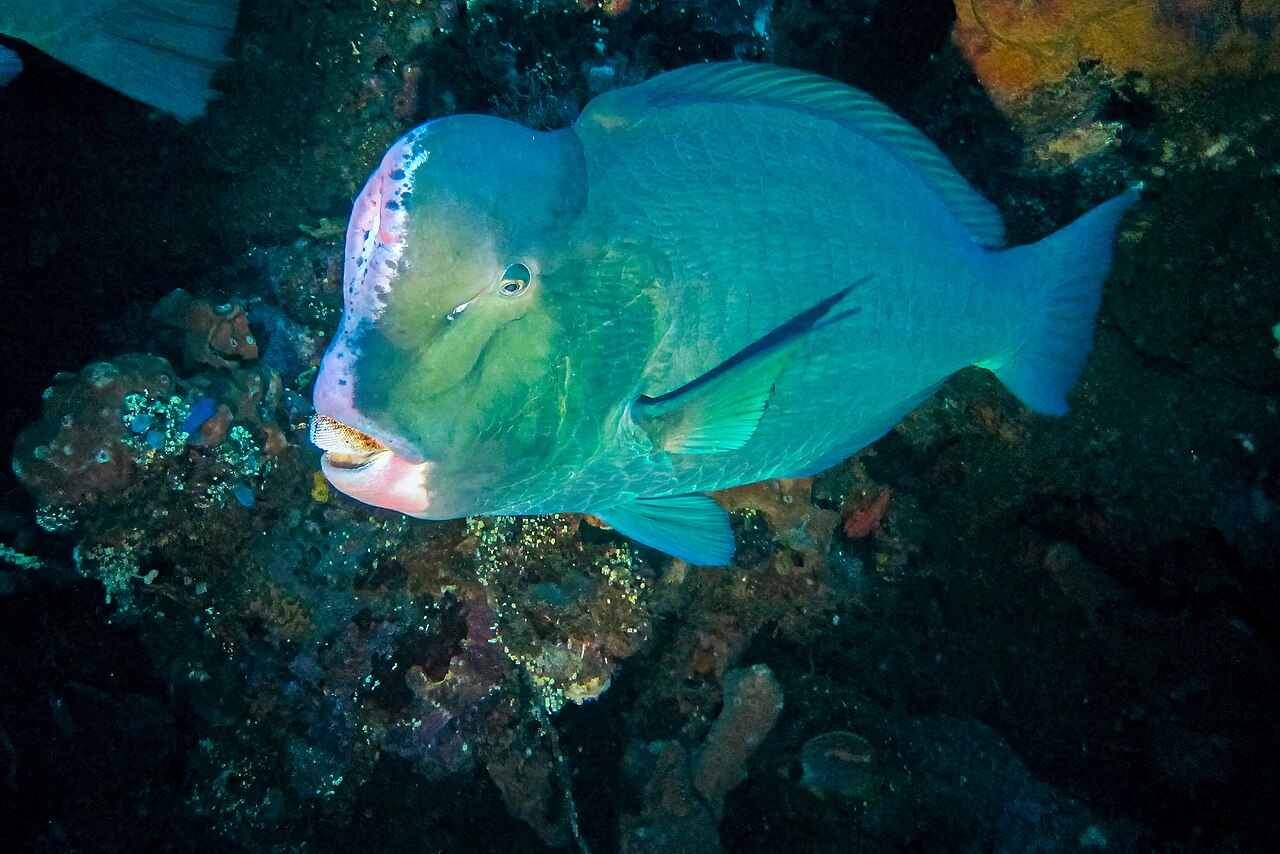
 Green humphead parrotfish (Bolbometopon muricatum), a large reef fish whose remains were identified among the Neolithic fish assemblage from Shimotabaru.
Image Credit:
Dirk Froebel, CC BY 4.0, via Wikimedia Commons
Green humphead parrotfish (Bolbometopon muricatum), a large reef fish whose remains were identified among the Neolithic fish assemblage from Shimotabaru.
Image Credit:
Dirk Froebel, CC BY 4.0, via Wikimedia Commons
Fish Bones Reveal a Reef-Based Way of Life in Neolithic Okinawa
A new analysis of fish remains from a Neolithic shell mound in Japan’s southern Ryukyu Islands is revealing how prehistoric island communities built their subsistence around coral reefs and shallow coastal waters, catching large parrotfish and sharks while apparently making little use of open-ocean resources.
The study revisits material excavated during the 1980s from the Shimotabaru shell mound on Hateruma Island, roughly 200 kilometres east of Taiwan. The site dates to around 3,700–3,200 years ago and belongs to a distinctive archaeological period in the southern Ryukyus marked by Shimotabaru pottery, a ceramic tradition that differed sharply from the earlier Jomon pottery found farther north in the Japanese archipelago. The Ryukyu Islands have a much longer history of seafaring. Humans had reached the archipelago by at least 37,000 years ago, crossing stretches of open sea and adapting to island environments over thousands of years. Yet the origins of the later Shimotabaru culture remain uncertain. Its appearance broadly overlaps with early Austronesian dispersals from Taiwan, but archaeological and genetic evidence doesn’t establish a simple connection between the two.
Fish bones now add another layer to that story. Earlier study of the Shimotabaru remains had identified 546 specimens from seven fish families. By examining a much wider range of skeletal elements—including vertebrae, teeth, jaw bones and other diagnostic parts—the new analysis identified 3,172 fish elements, with 1,413 specimens assigned at family level. At least 15 taxa were recognised, including five fish families that hadn’t previously been reported from the site. Parrotfish dominated the assemblage. Several genera were identified, including Scarus, Chlorurus and the spotted parrotfish Cetoscarus ocellatus. Some exceptionally large bones may belong to the green humphead parrotfish, Bolbometopon muricatum, although the researchers caution that distinguishing it from similar species using these bones alone is difficult. The abundance of large reef fish suggests that the waters surrounding Hateruma once supported substantial populations of species that could be targeted close to shore.
Sharks were also important. The revised analysis identified 166 shark remains, including vertebrae and teeth. Among the teeth, 40 were attributed to tiger sharks, and half of those had been perforated, suggesting that some were deliberately modified, perhaps for use as ornaments or tools.
The overall pattern points strongly toward reefs, lagoons and shallow coastal environments rather than the open sea. Moray eels, triggerfish, surgeonfish, groupers, barracuda and other species all fit this nearshore setting, while no clear evidence of pelagic fish was found. The variety of species nevertheless suggests that fishing wasn’t simple: different prey may have required nets, spears, traps, lines or other techniques adapted to particular reef habitats. Large tiger sharks raise the possibility that fishers occasionally ventured toward reef edges or outer reefs using small watercraft. Dugout canoes are known elsewhere in the Japanese archipelago thousands of years earlier, and stone adzes recovered from Shimotabaru and nearby islands point to woodworking skills that could have included boat building. But the study remains cautious. No boat has been found at Shimotabaru, and the use of watercraft there remains a plausible interpretation rather than direct archaeological evidence.
Another discovery concerns how the catch was processed. At least three fish bones preserve cut marks consistent with sharp tools, while re-examination of stone material identified 80 used quartz flakes and four chert flakes that may have served as cutting implements. Because these raw materials don’t naturally occur on Hateruma, they were probably brought to the island intentionally. The evidence provides the first indication that flaked stone tools were used at Shimotabaru to butcher and process fish.
Important gaps remain. The original excavation relied heavily on hand collection rather than systematic fine-mesh sieving, meaning small fish and juvenile specimens are probably underrepresented. No direct fishing equipment—such as hooks or nets—has yet been recovered, and some identifications remain limited by the available comparative collections. Even so, the picture is becoming clearer. The people of Neolithic Hateruma lived in a strongly maritime world, but their fishing strategy focused overwhelmingly on the productive waters close to shore. Rather than pursuing the deep ocean, they appear to have developed a flexible and highly adapted way of exploiting the reefs immediately around their island.
Published on: 12-10-2026
Edited by: Abdulmnam Samakie