- Archaeological News
-
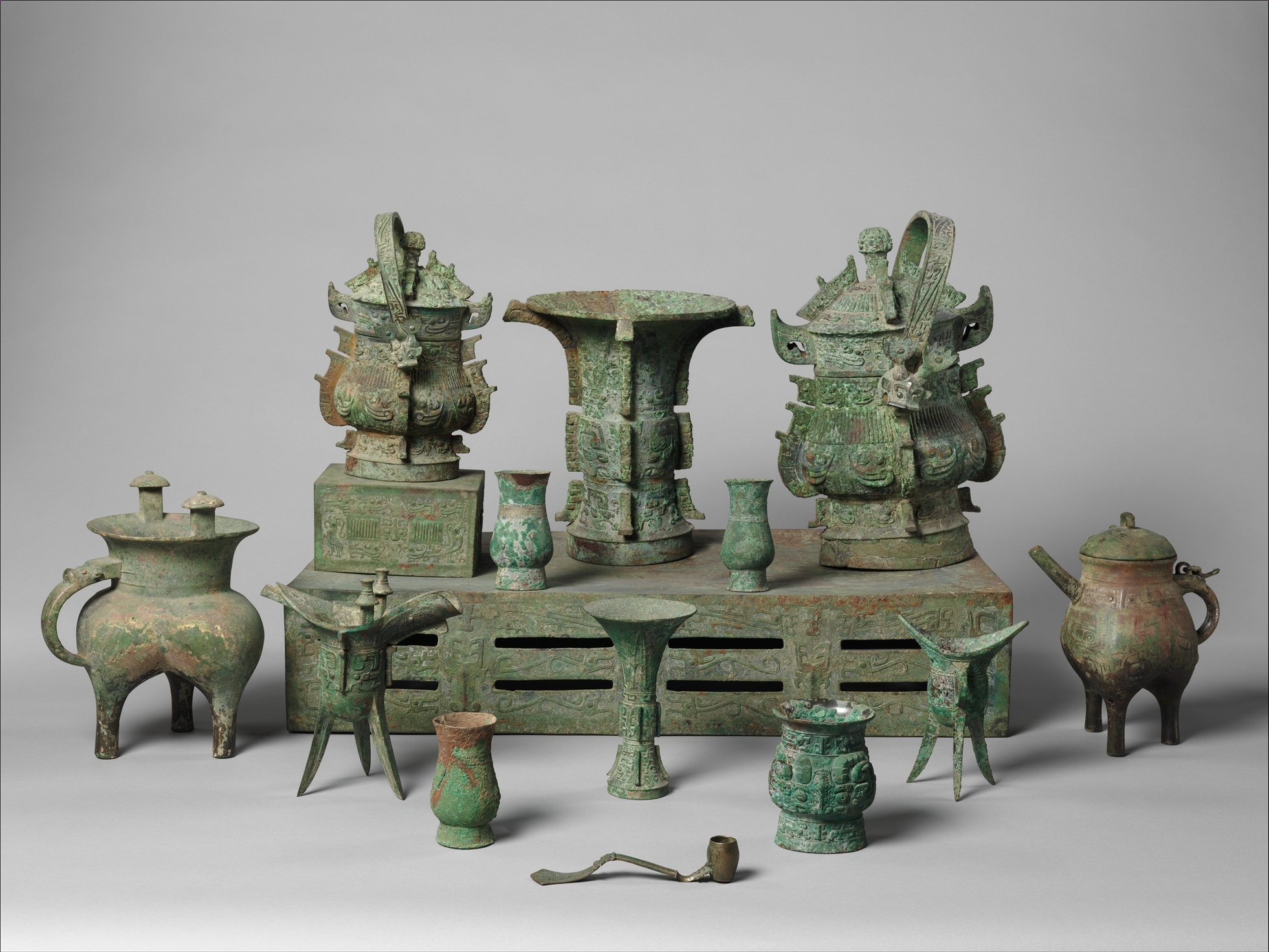
 A Western Zhou bronze altar set from the late 11th century BCE, illustrating the elaborate ritual vessel tradition that developed during China’s Bronze Age.
Image Credit:
Metropolitan Museum of Art, CC0, via Wikimedia Commons
Bronze Age China’s 700-Kilometre Copper Network Revealed
A new geochemical study has traced copper found at Bronze Age workshops in central China to mines about 700 kilometres farther south, revealing one of East Asia’s earliest known long-distance metal supply networks and showing how extensively the Shang world connected the Yellow and Yangtze river basins around 1400 BC.
Bronze production flourished during the Shang dynasty, when enormous quantities of ritual vessels were manufactured and deposited in tombs and ceremonial settings as symbols of status and political authority. Yet the copper, tin and lead needed for this industry weren’t available in substantial deposits near the Shang centres at Zhengzhou, raising a long-standing question: where did all that metal come from?
Tracing copper has been difficult because Shang bronzes were generally made by combining copper with tin and lead. Once these metals were mixed, the chemical signature of the original copper could become obscured, particularly because lead-isotope measurements often reflected the added lead rather than the copper ore itself. Instead of analysing finished bronzes, the new study turned to something closer to the beginning of the production process: pieces of copper ore recovered directly from ancient casting workshops.
The samples came from two major Upper Erligang-period sites associated with the Shang centres at Zhengzhou: Chuangxinjie and Xiaoshuangqiao. More than 400 pieces of copper ore were recovered from deposits at Chuangxinjie, while thousands were found at Xiaoshuangqiao alongside slags, crucibles, copper sheets and casting moulds. Their size distributions indicate that the ores had already been deliberately processed before reaching the workshops.
Researchers then compared several independent geological signatures rather than relying on one measurement alone. They examined lead isotopes, trace elements within chalcopyrite, the chemical composition of garnet associated with the copper ores and uranium-lead dates preserved in those garnet grains. Together, these methods progressively narrowed the possible source areas.
The evidence converged on the Jiurui mining district in the Middle Yangtze Valley, around 700 kilometres south of Zhengzhou. Garnet from the archaeological ores matched the geological age and composition expected for Jiurui, while lead isotopes and chalcopyrite chemistry helped eliminate competing mining regions. Statistical comparisons of garnet composition also gave Jiurui the strongest match among the remaining candidates.
An ancient copper-smelting site at Tónglǐng in Jiangxi provides an important link in the chain. Located within the Jiurui district and active during the Shang period, its smelting slags preserve unreacted garnet whose geological age, chemistry and lead-isotope characteristics closely match the ores recovered at Zhengzhou. This creates an unusually clear sequence from copper source, to smelting area, to workshops hundreds of kilometres away.
Such a route would have required considerable organization. The researchers argue that moving copper over roughly 700 kilometres to the northern political centres is more consistent with an organized supply system than with a simple chain of small exchanges between neighbouring communities. The network linked two of China’s most important river basins and helped sustain the dramatic expansion of bronze production during the Upper Erligang period.
The findings also strengthen the idea that the Shang expansion toward the south was partly connected to the search for strategic resources. Regional centres developed along these routes, and the movement of copper was accompanied by similarities in pottery, architecture and bronze traditions between the Central Plain and communities farther south. Metal wasn’t travelling alone.
Some caution remains. The analysed samples represent only part of the copper ore recovered from the two workshops, so other pieces may eventually reveal additional sources. Still, four independent geochemical indicators consistently point toward Jiurui as at least a major, and possibly the principal, supplier of copper to the Zhengzhou workshops.
The result turns ancient copper into evidence for something much larger: a Bronze Age system capable of obtaining essential resources from hundreds of kilometres away and moving them between major regions. Long before later imperial networks unified China on a far greater scale, metal was already connecting distant landscapes, workshops and political centres.
Published on: 24-10-2026
Edited by: Abdulmnam Samakie
Source: Nature Communications