- Archaeological News
-
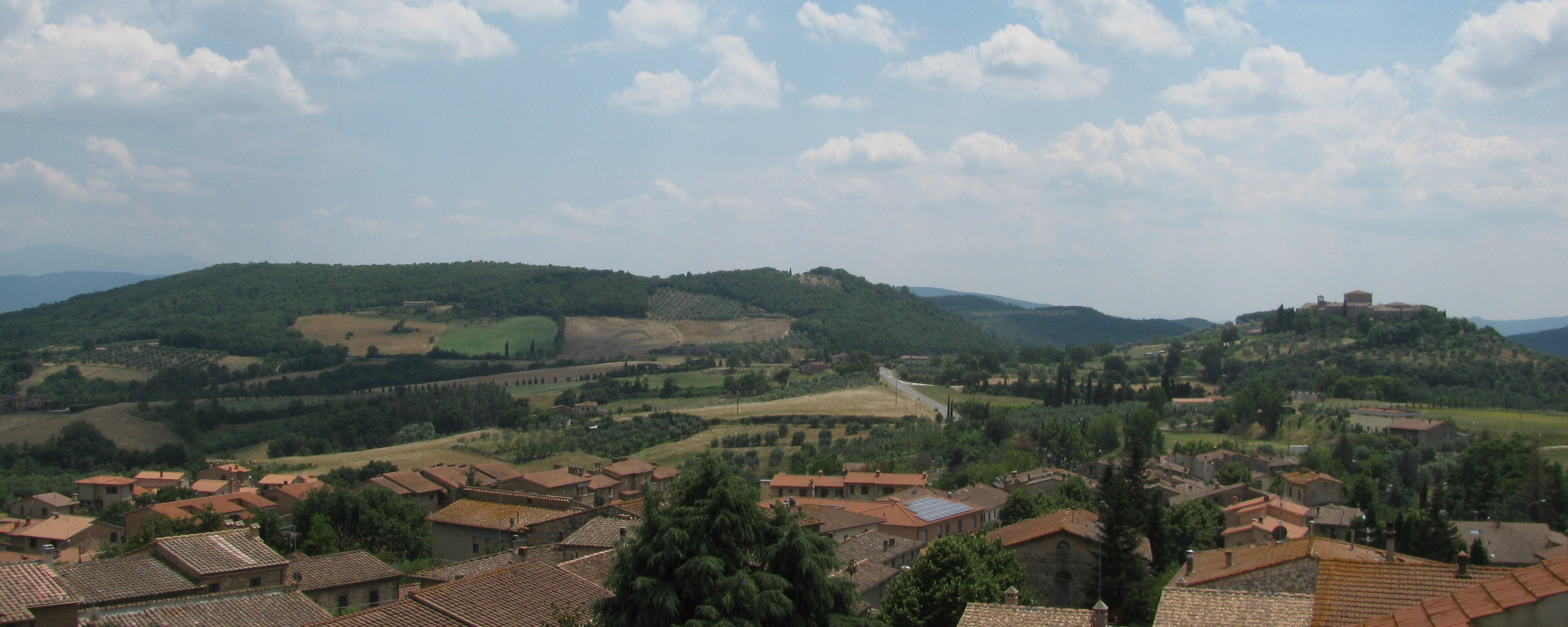
 View of Poggio Civitate (left), Poggio Aguzzo (centre) and Murlo (right) in Tuscany. Finds from Poggio Civitate, including inscribed objects bearing female names, have contributed to discussions of writing, identity and social relations in Etruscan society.
Image Credit:
Pax:Vobiscum, CC BY-SA 3.0, via Wikimedia Commons
Ancient Inscriptions Reveal How Writing Became Part of Life in Early Italy
Writing in ancient Italy was more than a system for recording words. It was scratched onto pottery, carved into stone, added to grave markers, placed on ritual objects and sometimes incorporated into everyday tools. A recent scholarly assessment of Ruth Whitehouse’s “Writing Matters: Italy in the First Millennium BCE” highlights how studying these inscriptions as physical objects can reveal who encountered writing, where it appeared and what social value it carried.
Writing spread through Italy unevenly. Different communities adopted it at different times and used it in different ways, making it misleading to treat early Italian literacy as a single process. The Etruscans became particularly prolific users, while other regions developed their own practices according to local social, cultural and linguistic conditions.
The earliest inscription currently known from Italy dates to around 775 BC. It appears as a short graffito on a pottery vessel from Osteria dell’Osa near Rome, written in a Euboean Greek script. Because only a fragment survives, scholars still disagree over whether the name it preserves was Greek, Etruscan or Latin.
Whitehouse’s approach shifts attention away from translating inscriptions alone and toward their physical form. The material, size and shape of an object, the position of the writing upon it, how visible it was and even how it might have been touched or handled all become part of the archaeological evidence. An inscription hidden inside a tomb, for example, created a very different experience from words carved onto a large monument visible across a public landscape.
This perspective is especially useful because writing survives on a remarkable variety of materials: pottery, stone, metal, bone and ivory. Perishable writing certainly existed as well, but almost all of it has vanished. One exceptional survival is the famous Etruscan Liber Linteus, a linen text preserved only because the cloth was later reused to wrap an Egyptian mummy now in Zagreb.
Several case studies illustrate how the presence of writing could change an object’s social meaning. At Bologna, inscriptions on the so-called Felsina funerary stelae show a slight association with larger monuments and richer burials, raising the possibility that writing helped commemorate individuals of higher status. The evidence, however, remains incomplete and doesn’t allow a firm conclusion.
At the sanctuary of Baratella near Este, inscribed bronze styluses were generally larger than uninscribed examples. Many seem to have been dedicated by women, offering intriguing evidence for connections between women, ritual activity and writing. Yet because many objects came from poorly recorded deposits, it remains difficult to reconstruct exactly how they were displayed or why inscriptions were added.
Other objects hint at an equally complex relationship between writing and gender. Two ivory tokens from Poggio Civitate bear female personal names. Such objects had sometimes been interpreted as markers of elite hospitality and exchange, activities traditionally assumed to belong largely to men. Their association with women challenges that assumption and suggests that elite Etruscan women may have participated more extensively in property, exchange and social networks than older interpretations allowed.
Writing also expressed identity. Personal names are common among early Italic inscriptions, suggesting that writing could identify individuals, strengthen social relationships and mark status. Some early inscriptions even speak in the first person, making the object itself appear to address the viewer—particularly on gifts, votive offerings and funerary monuments.
There are significant limits to this approach. Many inscriptions were discovered during nineteenth- or early twentieth-century excavations when archaeological contexts weren’t recorded to modern standards. Some objects are now lost and survive only in drawings, while short inscriptions may be difficult even to assign to a particular language.
The review also cautions against separating the material and linguistic sides of writing too sharply. Understanding what an inscription meant sometimes requires knowing not only what object carried it but what the words themselves said. The most productive future approach may therefore combine archaeology, linguistics, anthropology and the study of cognition rather than treating them as competing methods.
Seen this way, the history of writing in early Italy is not simply the story of alphabets spreading from one culture to another. It is also the story of objects carried, displayed, dedicated, buried and handled—and of the people who used those objects to communicate identity, memory and social relationships.
Published on: 29-10-2026
Edited by: Abdulmnam Samakie
Source: Journal of Roman Archaeology