- Archaeological News
-
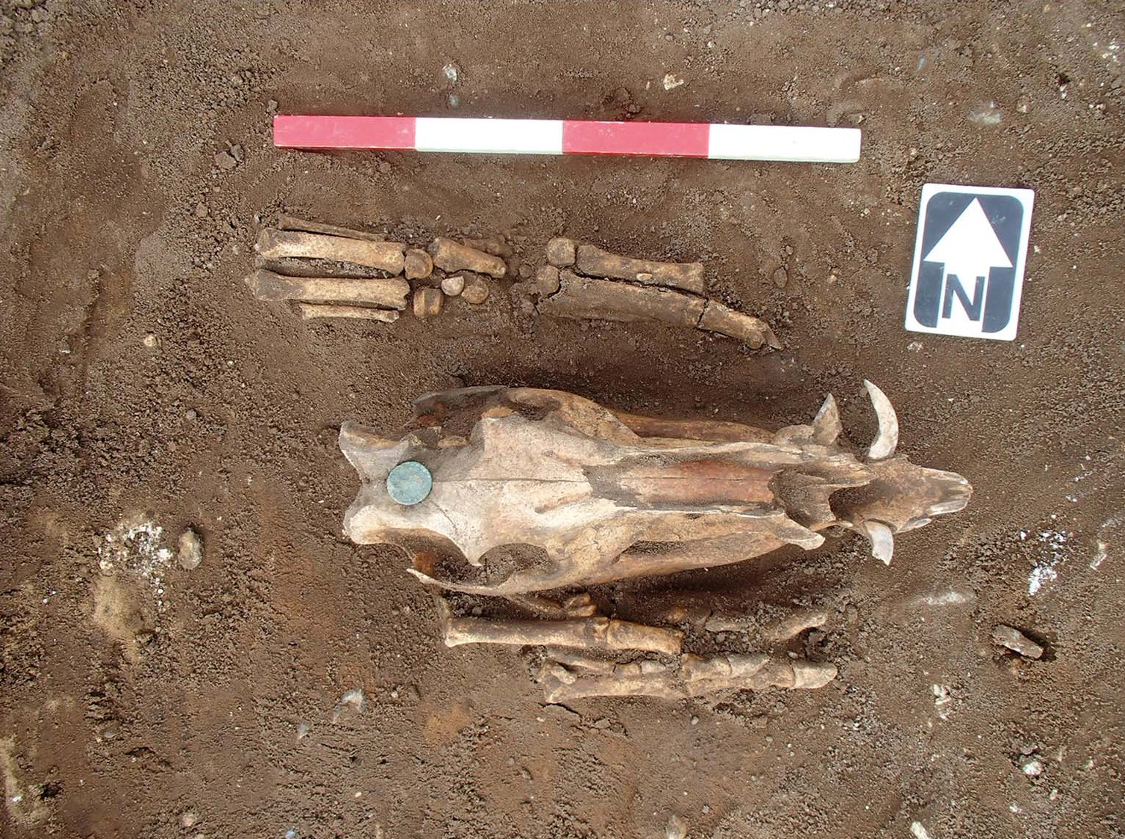
 Ritual pig head-and-hoof deposit found beside the Roman shrine at Red Lodge.
Image Credit:
Angus Forshaw, Britannia (2026)
Ritual pig head-and-hoof deposit found beside the Roman shrine at Red Lodge.
Image Credit:
Angus Forshaw, Britannia (2026)
Roman Shrine Reused a Bronze Age Barrow in Suffolk
Excavations at Red Lodge in Suffolk, England, have revealed how a prehistoric burial monument remained a focal point in the landscape for thousands of years, eventually becoming the centre of a Roman religious sanctuary.
The site was investigated in 2016 ahead of residential development. Archaeologists identified remains ranging from the Neolithic to the medieval period, but the most significant discoveries relate to an Early Bronze Age round barrow and its later transformation into a Roman sacred complex.
The barrow was defined by a circular ditch approximately 45 metres in diameter. Although its central mound and any associated burial had been destroyed by later farming, dating of the lower ditch deposits placed its construction between about 2200 and 1600 BC.
Very few other Bronze Age features were found nearby. Researchers suggest that the surrounding landscape may have been deliberately kept clear, emphasizing the visibility and sacred character of the monument.
The barrow apparently remained recognizable for centuries. By the Roman period, it had become the focus of a formal religious sanctuary.
Probably during the second century AD, a large rectangular sacred enclosure, or temenos, was constructed around the prehistoric monument. Measuring roughly 200 by 160 metres, it placed the ancient barrow near its centre. The enclosure contained relatively few ordinary settlement features, supporting its interpretation as a specialized ritual space.
A small shrine was later built immediately east of the barrow. The timber structure measured about five by 4.5 metres and probably consisted of a single room. Two possible column settings inside may mark the position of an altar.
Although the building itself was modest, its decoration was more elaborate. Archaeologists recovered around 48 kilograms of painted wall plaster, with white and red predominating alongside pink and green. Large quantities of roof tile indicate that the shrine probably had a tiled roof.
Some of the most unusual finds came from pits beside the shrine. Six deposits contained pig skulls accompanied by articulated limbs, creating distinctive “head-and-hoof” offerings.
The skulls were deliberately positioned facing east toward the shrine. Some had Roman coins placed directly on them, while staining on another skull suggests that a coin had originally been present there as well. The pits appear to have been reopened repeatedly to receive additional deposits over time.
Other animals also featured in structured deposits across the sanctuary. Archaeologists identified a complete dog burial associated with a horse shoulder blade, a cockerel with a cattle shoulder blade and antler, and a near-complete young cow placed on the opposite side of the barrow from the shrine.
The precise religious meanings of these deposits remain uncertain, and the study does not associate the sanctuary with a specific deity. However, their careful positioning supports an interpretation as deliberate ritual acts.
Coins and personal objects provide further evidence of votive activity. Of 52 coins recovered from the site, 27 were found close to the shrine and another 11 came from the adjacent barrow ditch. Brooches, pins, tweezers and fragments of copper-alloy votive plaques were also concentrated around this area.
A possible well, pond and tile-lined oven or flue suggest that other activities occurred within the sanctuary. Water may have been connected with cleansing, while the oven could have been associated with food preparation or ritual burning, although the evidence does not allow these functions to be established with certainty.
Religious activity appears to have continued into the fourth century AD before gradually declining. The evidence suggests abandonment rather than a single deliberate destruction event.
The location retained significance even after the Roman sanctuary disappeared. A medieval burial dated to AD 1169–1266 was placed in the former enclosure ditch. Documentary sources also refer to a thirteenth-century gallows in the vicinity, although no archaeological remains of the structure were found and the burial cannot be confirmed as an execution victim.
The Red Lodge discoveries illustrate how an ancient monument could acquire new meanings across successive periods. A Bronze Age funerary mound became the centre of a Roman sanctuary more than a millennium later, demonstrating the enduring importance of prominent prehistoric places in later religious landscapes.
Published on: 12-08-2026
Edited by: Abdulmnam Samakie
Source: Britannia