- Archaeological News
-
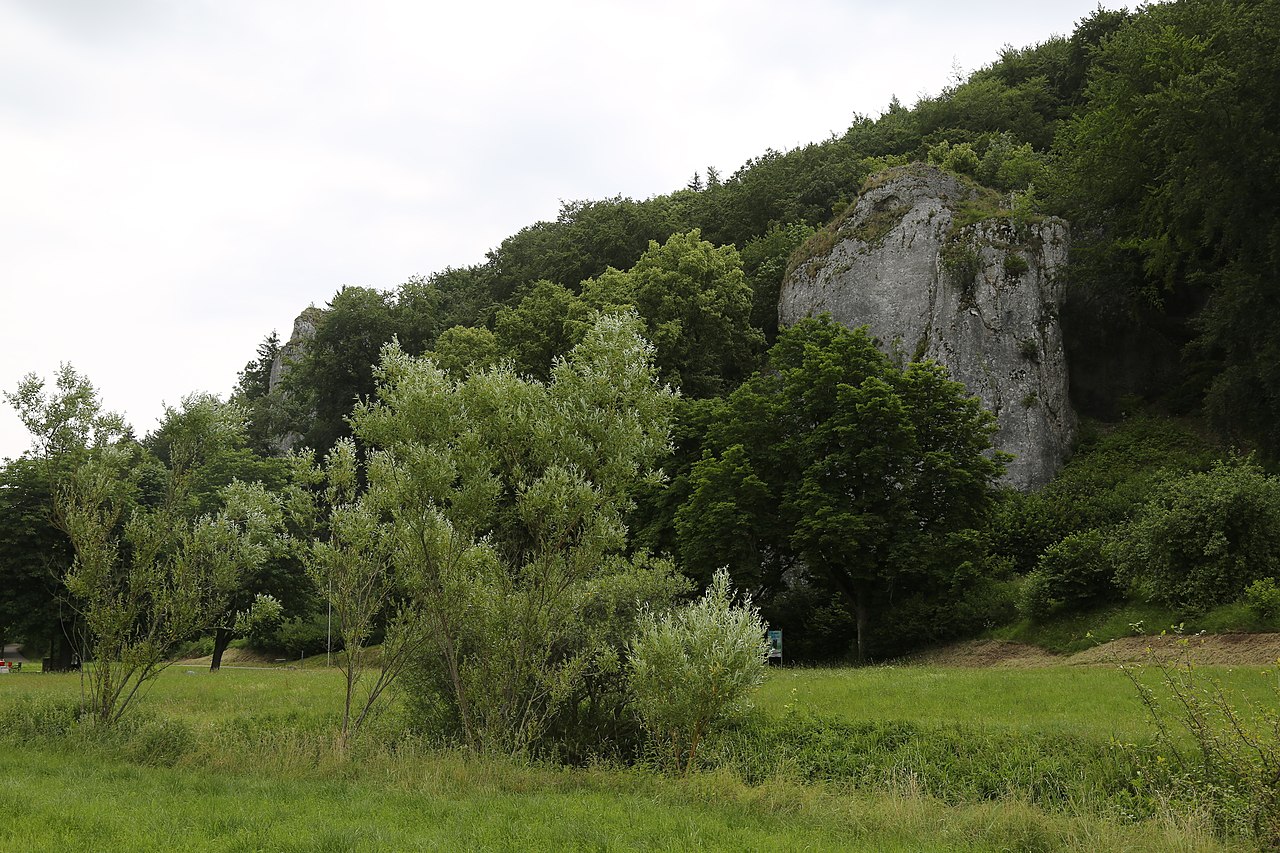
 Hohle Fels cave near Schelklingen in southwestern Germany, an important Upper Paleolithic archaeological site in the Swabian Jura.
Image Credit:
Henning Schlottmann, CC BY-SA 4.0, via Wikimedia Commons
New Digital Tool Opens Three Million Years of Human Prehistory to Researchers
A new open-access digital tool is making one of the world’s largest collections of archaeological and paleoanthropological data easier to explore, giving researchers direct access to evidence spanning almost three million years of human history across Africa and Eurasia.
The tool, called roadDB, connects the statistical programming language R with the ROCEEH Out of Africa Database (ROAD), a major research archive devoted to human evolution and early prehistory. ROAD brings together archaeological sites, stone tools, human fossils, animal and plant remains, dating evidence and environmental information within the same geographical and chronological framework. Until now, researchers could explore and download these records through several online interfaces, but carrying out large, repeatable analyses often required considerable technical work.
The scale is substantial. ROAD currently contains more than 29,000 archaeological assemblages from over 2,700 locations, compiled from more than 6,500 scientific publications in over ten languages. Its chronological coverage stretches from around three million to 20,000 years ago, encompassing much of the period in which different human species evolved, dispersed across continents and developed increasingly complex technologies and cultural behaviours. Bringing all of that evidence together is increasingly important as archaeology moves beyond individual sites to questions covering entire regions and vast spans of time. Researchers can, for example, compare the geographical spread of different stone-tool traditions, examine changes in archaeological remains across hundreds of thousands of years, or combine information about human occupation with reconstructions of ancient climate and vegetation.
roadDB is designed to make such work more direct. Instead of manually downloading tables and repeatedly reorganising them, researchers can write commands in R that request specific information from ROAD according to location, time period, cultural tradition or type of archaeological evidence. Results are returned in a standardized format that can be immediately connected to mapping, statistical, chronological and environmental-analysis tools. The system can work at several scales. Researchers may retrieve information about entire archaeological sites, move down to individual assemblages and their contents, or access specific records such as radiocarbon dates and publications. Separate functions can search for stone-tool types and raw materials, symbolic objects, organic tools, human fossils, animal remains and botanical evidence.
Tests included in the research demonstrate how broad those possibilities can become. One analysis mapped more than 2,100 archaeological localities across Africa and Eurasia, while another examined the temporal distribution of 29,087 assemblages between three million and 20,000 years ago. Other examples combined archaeological information with reconstructed temperatures from the Hohle Fels cave in Germany and calibrated radiocarbon dates associated with an Aurignacian archaeological layer.
A key goal is reproducibility. roadDB works through a regularly updated copy of the main ROAD database rather than querying the continuously changing production system directly. This “snapshot” is updated every three months and can be identified by version, allowing researchers to record exactly which dataset underpinned a particular analysis. That matters because the same query may produce different results after new sites or publications are added.
The developers nevertheless stress that easier access doesn’t remove the need for archaeological judgement. ROAD draws on more than 150 years of scholarship produced in different languages and research traditions, meaning that inconsistencies, errors and subjective interpretations can remain. Researchers are therefore encouraged to save copies of the data they use and check important records against the original publications and newer research.
The significance of roadDB lies less in producing a single new discovery than in changing how discoveries can be made. By placing an enormous archaeological archive directly inside a reproducible analytical environment, it gives researchers a faster way to connect sites, environments, dates and material culture across scales that would once have been difficult to study together. Three million years of human prehistory have become a little easier to navigate.
Published on: 13-10-2026
Edited by: Abdulmnam Samakie
Source: PLOS One