- Archaeological News
-
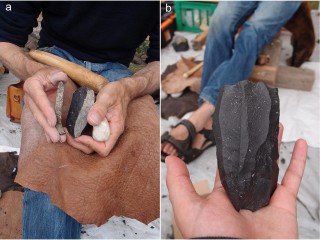 Experimental production of rhyolite blades using an antler punch, with the prepared rhyolite core shown at right.
Image Credit:
Knutsson et al., Journal of Archaeological Science (2026)
Microscopic Wear Reveals How Stone Blades Were Reused 10,000 Years Ago in Arctic Finland
Microscopic traces preserved on stone tools from northern Finland are revealing how hunter-gatherers used, reused and transformed their equipment around 10,000 years ago. Analysis of rhyolite blades from the Early Mesolithic site of Sujala shows that seemingly simple broken blade fragments were often functional tools used for cutting, scraping, grooving and working materials including wood, plant matter and hides.
Sujala lies beside Lake Vetsijärvi in Finnish Lapland, about 60 kilometres from the Norwegian Arctic coast. Excavations uncovered a circular dwelling approximately 3.5 metres across with a central hearth, together with thousands of stone artifacts. Radiocarbon evidence places occupation around 8300–8200 BC. Burnt reindeer remains and bones of waterbirds that occur in the region during the open-water season contributed to an interpretation of the site as a seasonal camp, probably occupied during autumn.
The stone assemblage is exceptional for Finland. More than 6,500 artifacts were recovered from the two investigated areas, including over 2,000 blades and blade fragments. Their manufacturing technique belongs to a pressure-blade tradition with close parallels in northwestern Russia and northern Norway. The technology reached northern Fennoscandia after deglaciation as groups and technical knowledge moved northwestward.
The new investigation concentrated on 53 artifacts, most of them fragments rather than complete formal tools. Researchers first examined larger traces of damage and modification under low magnification and then studied microscopic polish, rounding and striations at higher magnification. Fifteen pieces were substantially weathered, making detailed analysis difficult, but many better-preserved artifacts retained identifiable traces of use.
The results show that broken blades were far from useless waste. Twenty-five medial fragments—the middle sections of deliberately or accidentally snapped blades—included several pieces whose rounded edges, polished surfaces and microscopic scratches indicated repeated use. Different wear patterns suggest contact with different materials. One group most closely resembled experimental tools used on moist, silica-rich materials such as wood or reeds, while another showed similarities to hide-working tools. Because the experimental rhyolite differed from the archaeological material, however, these identifications remain provisional.
The direction of the wear also revealed how some tools were handled. Medial blade fragments appear to have been pushed away from the user, with the corner formed by a snapped end pressed into the worked material. Their edges penetrated only shallowly, and researchers suggest that some may have been mounted in handles. Proximal blade fragments show a different movement: they were probably drawn toward the user during cutting. Four of eight examined proximal fragments carried wear consistent with cutting silica-rich materials, while another two appear to have cut softer but abrasive substances.
Formal scrapers provided additional evidence. Two showed traces consistent with scraping a soft but abrasive material, with semi-fresh hide proposed as one possibility requiring further experimentation. A burin carried wear comparable with working a resistant material, while some pointed or retouched fragments appear to have been used for boring or scraping. One arrowhead tang even preserved a fracture that may have formed when the point was driven against its shaft during impact.
Perhaps the most revealing pattern is the repeated transformation of individual objects. Larger blades could begin as cutting or sawing tools and later be converted into burins, scrapers, borers or potentially arrowheads. Narrower snapped fragments were also used as working implements despite requiring little additional shaping. The artifacts therefore passed through complex life histories of use, repair and repurposing before being discarded.
These findings strengthen the interpretation of Sujala as more than a temporary hunting stop. The inhabitants hunted and processed animals while also producing, maintaining and modifying equipment made from both stone and organic materials. The range of activities suggests a broader seasonal camp where multiple tasks were carried out.
The study also demonstrates that microscopic use-wear analysis can recover valuable behavioural information even from rhyolite, a volcanic rock whose uneven structure and weathering make such analysis difficult. At the same time, the researchers caution that better experimental collections made from closely matching raw material will be essential before specific contact materials can be identified with greater confidence.
Published on: 20-09-2026
Edited by: Abdulmnam Samakie