- Archaeological News
-
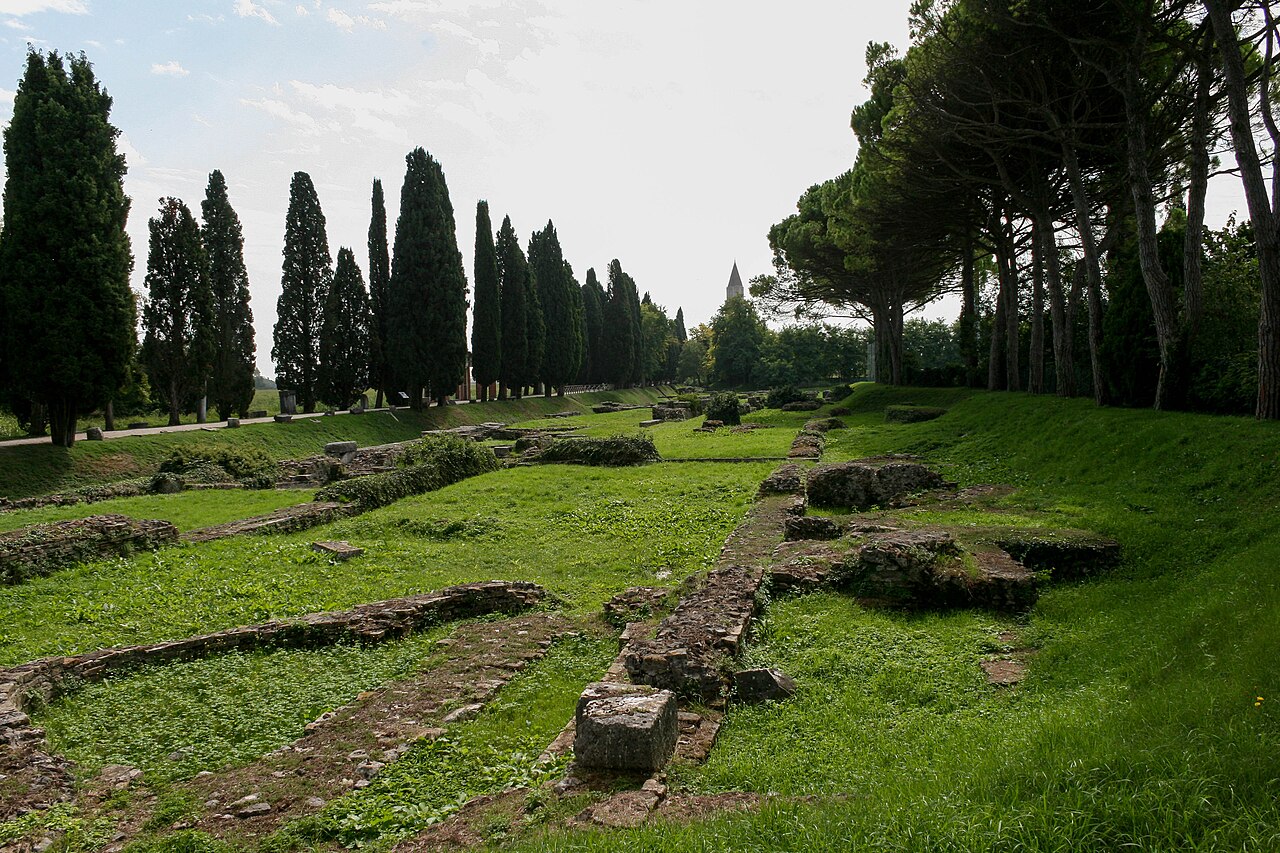
 Ruins of the ancient river port of Aquileia, northern Italy, with the basilica visible in the background.
Image Credit:
Marco Almbauer, via Wikimedia Commons
Ruins of the ancient river port of Aquileia, northern Italy, with the basilica visible in the background.
Image Credit:
Marco Almbauer, via Wikimedia Commons
Roman Mortar Reveals How Aquileia Was Built Across Eight Centuries
A large-scale archaeometric study of construction materials from ancient Aquileia in northern Italy is offering a detailed look at how Roman builders selected materials, organised labour, reused resources and changed their techniques over more than eight centuries.
The research focuses on something archaeology has often treated as background material: mortar. By analysing mortars alongside concrete, cocciopesto, floors and plaster, the study places binding mixtures at the centre of the construction process rather than viewing them as secondary elements. More than 370 samples—over 430 when individual layers are counted—were examined from public buildings, private houses, monuments and functional structures dating from the 2nd century BC to the 6th century AD.
The material came from a wide range of locations across Aquileia, including the city walls, theatre, amphitheatre, baths, river port and residential complexes. Researchers combined petrographic, mineralogical and microchemical methods, using techniques such as optical microscopy, electron microscopy, spectroscopy and X-ray diffraction to examine the composition and origin of the mixtures. The goal was not simply to identify ingredients, but to reconstruct how materials were produced, where they came from and how they were used within different building projects.
What emerges is a picture of Roman construction as a highly organised activity in which walls, floors and decorative surfaces were closely connected. Structural mortars show considerable standardisation, with lime-based mixtures repeatedly associated with particular construction techniques. Flooring systems also followed recurring practices, though builders showed greater flexibility in their choice of coarse or recycled materials. Plasters varied more in their aggregates and additives, reflecting the specialised requirements of decorative work.
These differences appear to reflect specialised teams working at different stages of construction. Plaster mixtures, for example, were generally more refined than those used in masonry or flooring, while similarities across several types of mixtures suggest that materials and knowledge circulated between groups working on the same site.
Recycling was common. Shell fragments, crushed plaster, tile-working debris and different sands were incorporated into mortars throughout the long history of Aquileia. In some cases, the study even raises the possibility that sand associated with ship ballast was reused in construction near the port. Such microscopic traces reveal practical decisions that rarely appear in written sources: how builders economised materials, managed supplies and adapted to what was locally available.
Water supplies also mattered. Mortar production required large quantities of water, and evidence from some peripheral construction areas suggests that builders may occasionally have used brackish canal water. Yet the mixtures prepared for painted plaster lack the same saline indicators, implying that craftspeople were more selective about water quality when producing decorative surfaces.
The long chronological sequence also reveals changing construction traditions. During the Late Republican period, building mixtures closely followed technical practices associated with central Italy. With the beginning of the Imperial period, local craftspeople appear to have gained greater control over building and decorative techniques, producing increasingly standardised recipes while developing regional working traditions. From the 3rd century AD onward, and especially during Late Antiquity, mixtures and preparatory layers became more varied and less closely tied to earlier prescriptions.
That change doesn’t necessarily indicate declining craftsmanship. The materials remained good, while builders increasingly relied on flexible solutions suited to changing decorative preferences, working conditions and technical traditions. The evidence instead points to adaptation.
The study also shows how mortar itself may become a chronological tool. Differences in composition and preparation can help distinguish construction phases and, when combined with archaeological context, may even contribute to identifying particular workshop traditions. Recent attempts to date lime mortars directly through radiocarbon analysis could sharpen this approach further.
Aquileia therefore offers more than a history of mortar. Its building mixtures preserve evidence of labour, supply networks, recycling, technical knowledge and economic choices, showing how seemingly ordinary materials can reveal the organisation of Roman construction at an unusually detailed level.
Published on: 05-10-2026
Edited by: Abdulmnam Samakie
Source: Journal of Roman Archaeology