- Archaeological News
-
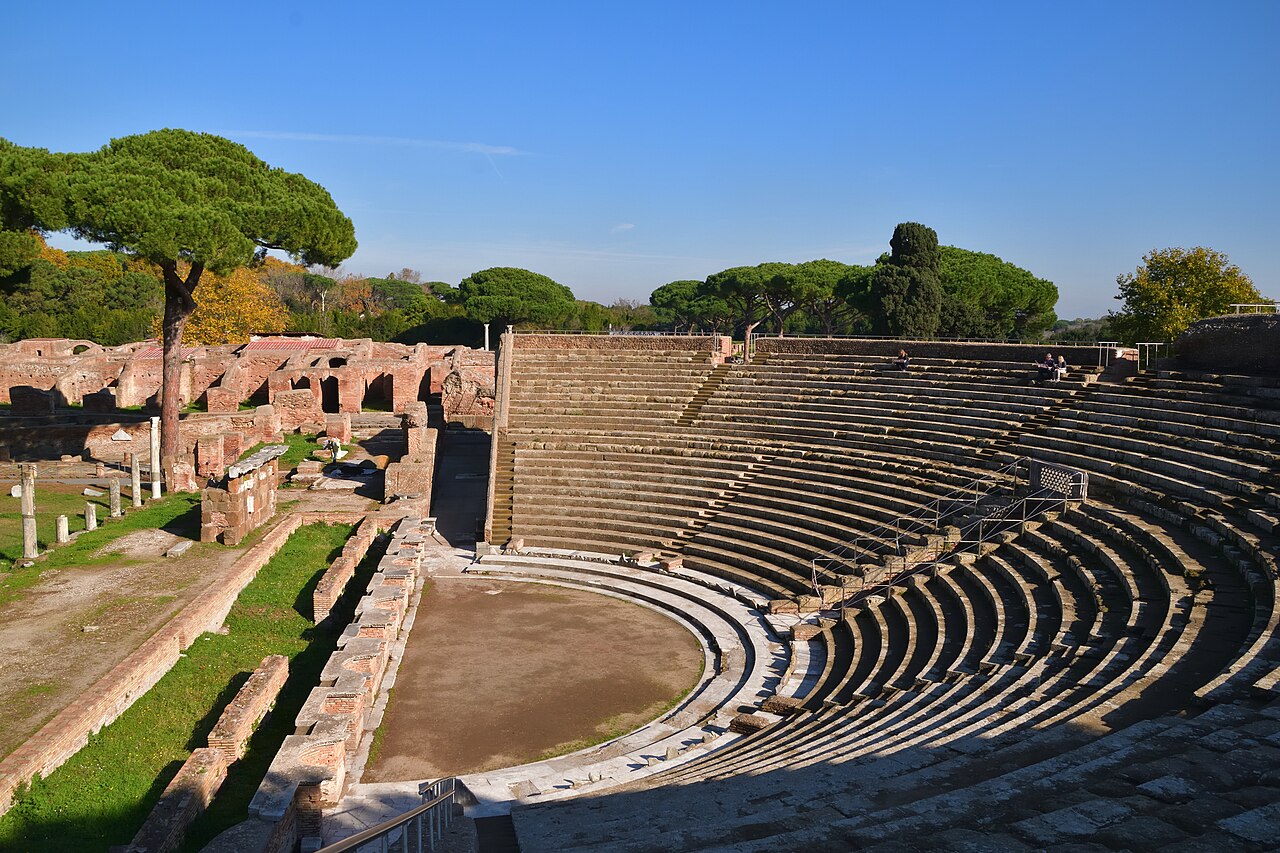
 The ancient Roman theatre at Ostia Antica, one of the four Mediterranean cities examined in the study of residential architecture and housing patterns.
Image Credit:
Rabax63, CC BY-SA 4.0, via Wikimedia Commons
The ancient Roman theatre at Ostia Antica, one of the four Mediterranean cities examined in the study of residential architecture and housing patterns.
Image Credit:
Rabax63, CC BY-SA 4.0, via Wikimedia Commons
Ancient Homes in Four Mediterranean Cities Followed the Same Hidden Pattern
A new study of almost 2,000 residential units from Pompeii, Delos, Herculaneum and Ostia has uncovered a remarkably consistent relationship between the size of ancient homes and the number of rooms they contained, suggesting that households in very different Greek and Roman cities organized domestic space according to similar underlying patterns.
The research expands earlier work at Pompeii to three additional settlements with very different histories, populations and architectural traditions. Delos developed into a major trading centre during the late Hellenistic period, Pompeii and Herculaneum preserve domestic landscapes largely frozen by the eruption of AD 79, while much of Ostia’s surviving housing belongs to the second and third centuries AD. Their homes also looked very different, ranging from courtyard and atrium houses to shops, mixed residential-commercial buildings and apartment complexes.
Yet beneath those differences, the same mathematical pattern repeatedly appeared. Researchers compared the ground-floor area of each residential unit with its number of rooms, drawing on existing archaeological catalogues, maps, plans and GIS measurements. The final dataset included 153 units from the Theater district of Delos, 965 from Pompeii, 43 from Herculaneum and 832 from Ostia—just under 2,000 properties altogether.
As houses became larger, their number of rooms increased too, but not at the same rate. In other words, doubling the floor area of a property didn’t normally mean doubling its rooms. Across the full housing samples, the relationship was strikingly similar: the statistical exponent was 0.80 at Pompeii, 0.83 at Delos, 0.88 at Herculaneum and 0.81 at Ostia. All of the relationships were highly statistically significant.
The pattern became even clearer when shops and workshops were separated from houses and apartments. For residential properties alone, the number of rooms increased at roughly two-thirds the rate of total floor area: 0.70 at Delos, 0.64 at Pompeii, 0.68 at Herculaneum and 0.69 at Ostia. Despite differences in architecture, decoration and social setting, the figures remained remarkably close.
That matters because it suggests that larger ancient homes weren’t simply scaled-up versions of smaller ones. As floor area increased, households apparently devoted proportionally more space to individual rooms rather than continually adding new ones. The researchers interpret rooms as a form of infrastructure for social interaction, shaped not only by the people who lived in a house but also by relatives, friends, dependants, clients and others who regularly entered domestic space.
The study also explored how housing changed with city size, although these comparisons are more tentative because only four settlements were included. The results suggest that average residential properties became smaller as urban populations increased, reflecting greater pressure on available land. Surprisingly, however, the average rooms themselves appear to have become somewhat larger, even as households occupied smaller properties with fewer rooms.
The differences between the four housing stocks are substantial. Average ground-floor area ranged from about 84 square metres at Ostia to 251 square metres at Herculaneum, while the average number of rooms ranged from 2.6 at Ostia to 13.3 at Herculaneum. Even so, those very different housing traditions followed nearly the same underlying scaling relationship.
The researchers also examined possible differences in social and economic inequality using house size as a proxy for wealth. Their preliminary results suggest that larger settlements may have been somewhat less unequal, but they stress that the sample of cities is too small for strong statistical conclusions.
There are other limitations. Only ground-floor areas could be compared reliably, even though upper stories existed at several sites, and the researchers didn’t attempt to reconstruct how individual buildings changed through time or determine the precise function of every room. The boundaries between houses, shops and workshops can also be difficult to define archaeologically.
Still, the similarity across four very different cities suggests that the pattern first identified at Pompeii wasn’t unique. Ancient domestic architecture may preserve measurable traces of the same broader forces that shaped social networks and urban space—turning the ordinary arrangement of rooms into evidence for how people organized life inside some of the Mediterranean’s best-known cities.
Published on: 17-10-2026
Edited by: Abdulmnam Samakie
Source: Journal of Roman Archaeology