- Archaeological News
-
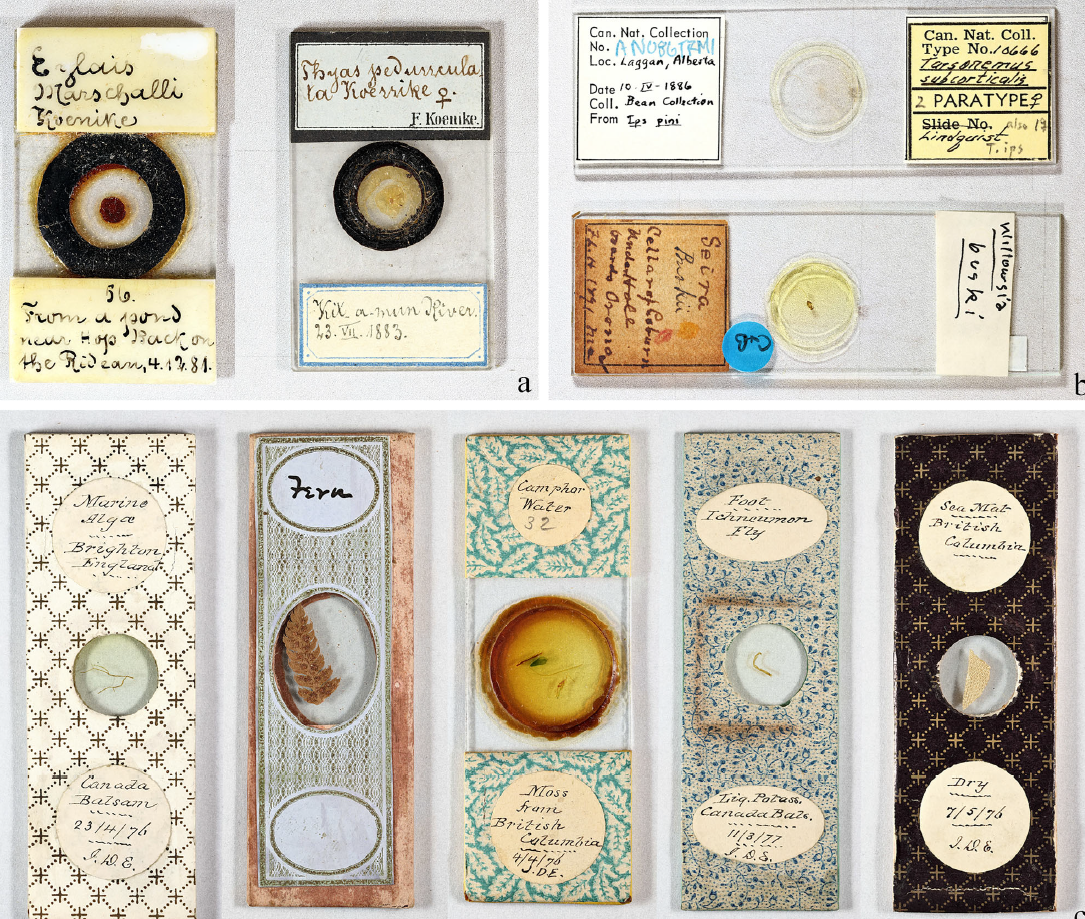
 Historic microscope slides from the Canadian National Collection, including decorated paper-wrapped examples from the Evans collection.
Image Credit:
Lonsdale et al., npj Heritage Science (2026)
Historic microscope slides from the Canadian National Collection, including decorated paper-wrapped examples from the Evans collection.
Image Credit:
Lonsdale et al., npj Heritage Science (2026)
A Hidden Arsenic Legacy in Canada’s Scientific Collections
A new heritage-science study has identified arsenic and several heavy metals in a group of 19th-century microscope slides held in a Canadian natural history collection, highlighting hidden hazards that can remain in apparently ordinary historic scientific objects.
The research examined Victorian-era microscope slides wrapped in decorative paper and produced in Canada between 1874 and 1878. The slides are part of a group of 190 specimens donated in 2025 to the Canadian National Collection of Insects, Arachnids and Nematodes in Ottawa.
Although the preserved biological specimens themselves are relatively common, the slides are notable for their ornate paper coverings, construction techniques and historical value. Some wrappers feature vivid colours and repeating decorative patterns typical of Victorian material culture.
Researchers became particularly interested in several bright green slides because their colour resembled historic papers known to contain arsenic-based pigments, especially the intensely coloured emerald green widely used during the 19th century.
At the time, synthetic pigments containing arsenic, lead, chromium and mercury were commonly used in wallpapers, books, textiles, paints and other manufactured goods. Their bright colours made them highly desirable, even as awareness of their toxicity gradually increased.
To investigate the slides without damaging them, researchers selected ten examples representing different wrapper colours and analysed them using portable X-ray fluorescence, or pXRF. The technique identifies elements by measuring the characteristic X-rays they emit when exposed to high-energy radiation.
The results revealed considerable variation between slides that looked superficially similar. Two green wrappers produced particularly strong signals for both copper and arsenic. This combination is consistent with an arsenical green pigment system and was compared with an emerald green reference sample from the Canadian Conservation Institute.
The researchers consider emerald green the most plausible explanation, although they caution that pXRF identifies elements rather than specific chemical compounds and therefore cannot confirm the exact pigment without additional testing.
Other slides contained combinations of potentially hazardous elements including lead, chromium, mercury and copper. Arsenic was also detected at low levels in most of the samples, but this produced an important surprise. A clear, unwrapped glass slide also contained arsenic. This indicates that some of the arsenic detected in the collection probably came from the glass itself rather than from toxic decorative pigments. Arsenic compounds were historically used in glassmaking as refining and decolourising agents.
The finding demonstrates why simply detecting arsenic is not enough to conclude that an object contains arsenical paint or paper. Researchers must consider how different elements occur together and compare results with untreated materials.
The study also found that appearance alone provides little indication of chemical composition. Slides with similar colours sometimes contained very different materials, while potentially hazardous metals occurred in wrappers of several colours.
This variability may reflect the realities of scientific craftsmanship in 19th-century Canada. Decorative and specialised papers were not always readily available, particularly outside major centres. Microscopists and other craftspeople may have reused imported decorative papers, printed sheets, book fragments or locally available stationery. As a result, even slides prepared by the same person over a relatively short period could contain very different pigments, fillers and paper compositions.
Despite the presence of hazardous substances, the researchers stress that such objects should not automatically be regarded as dangerous to access.
The slides represent what the study describes as a high-hazard but relatively low-exposure collection when they remain stable and are handled under controlled conditions. The greatest risks arise when degraded pigments or paper generate dust that can be inhaled or transferred during cleaning and repeated handling.
Recommended precautions include gloves, careful handwashing, reducing abrasion, controlling dust and humidity, proper storage and warning labels. Digitisation can also reduce unnecessary physical handling.
The broader significance extends beyond microscope slides. Similar hazardous pigments occur in historic books, wallpapers, decorative papers, artworks and scientific collections.
The study therefore argues that non-destructive testing can help museums identify hidden hazards without limiting access to historic collections. More importantly, it shows that Victorian colour can conceal a surprisingly complex chemical history—and that two objects that look alike may require very different approaches to conservation and handling.
Published on: 23-08-2026
Edited by: Abdulmnam Samakie
Source: npj Heritage Science