- Archaeological News
-
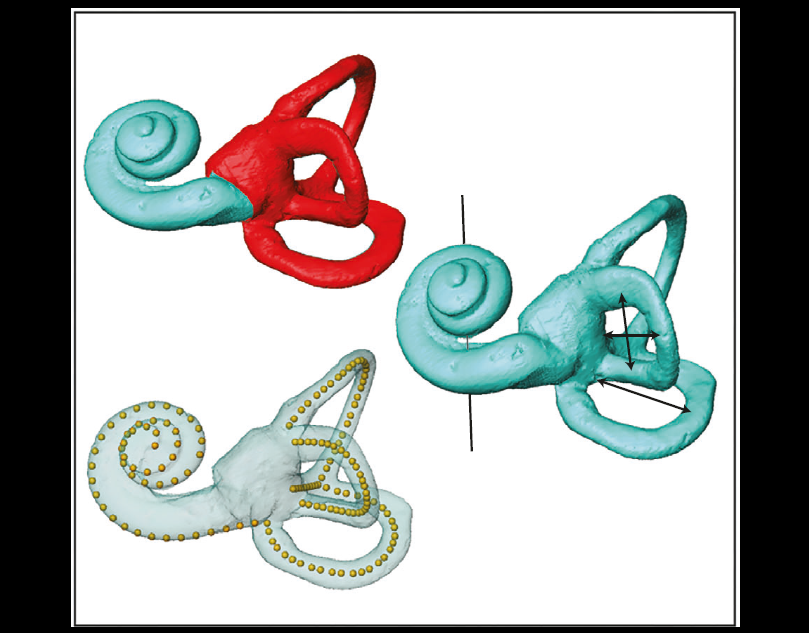
 3D representations of the bony labyrinth showing the methods used to compare inner-ear shape.
Image Credit:
Martin et al., Nature Communications (2026)
3D representations of the bony labyrinth showing the methods used to compare inner-ear shape.
Image Credit:
Martin et al., Nature Communications (2026)
Ancient Inner Ears Reveal a Hidden History of Nile Valley Populations
A new study of prehistoric human remains from northeastern Africa has used the anatomy of the inner ear to reconstruct population history across tens of thousands of years, revealing long-term continuity among ancient hunter-gatherers followed by a major demographic shift with the spread of Neolithic food production.
Because ancient DNA is rarely preserved in northeastern Africa, reconstructing population relationships has been particularly difficult. The new research instead focuses on the bony labyrinth, a system of cavities inside the temporal bone that contains the organs of hearing and balance. Its shape is strongly influenced by ancestry and can therefore provide clues to biological relationships between populations.
Researchers analysed 194 bony labyrinths belonging to 148 individuals dating from approximately 44,000 to 3,000 years ago. The sample included remains from the Middle Nile Valley in southern Egypt and Sudan, the Horn of Africa and Central Africa, together with comparative specimens from prehistoric Africa, Europe and the Levant.
Three independent methods were used to compare the shape of the semicircular canals, vestibule and other components of the inner ear. All produced broadly similar results.
One of the clearest patterns was continuity among hunter-gatherers of the Middle Nile Valley. Individuals from the Late Pleistocene and Early Holocene displayed similar inner-ear morphology, suggesting longstanding regional ancestry.
They also showed similarities to substantially older Homo sapiens fossils from Africa, including individuals such as Nazlet Khater 2 from Egypt, Ishango 37 from Central Africa and Hofmeyr from southern Africa. The findings suggest deep biological roots for some hunter-gatherer populations living along the Nile.
The situation changed markedly with the Neolithic transition beginning around 8,000 years ago.
Individuals associated with food-producing communities displayed different bony labyrinth shapes from earlier hunter-gatherers. The researchers interpret this as evidence of significant biological discontinuity, supporting previous studies of dental morphology that had suggested the arrival or expansion of populations with different biological affinities alongside the emergence of farming and herding.
The transition was not absolute, however. Some individuals from desert areas west and east of the Nile retained morphological affinities with earlier foragers long after food production had appeared.
This suggests that hunter-gatherer-related populations may have persisted in some areas and interacted with newly arrived or expanding food-producing communities. In a few cases, individuals displayed characteristics intermediate between the two groups.
The study also identified unusually high biological diversity in samples from the Horn of Africa and Central Africa. Even individuals from the same archaeological sites sometimes displayed substantially different inner-ear morphologies.
Researchers suggest that this diversity may reflect complex population structures, migrations and interaction between biologically distinct groups during the Holocene rather than a single homogeneous population history.
Another striking discovery involved a group of 13 individuals, most of them Early Holocene hunter-gatherers from the Middle Nile Valley, whose inner ears showed unusual shapes. Several also displayed rare congenital abnormalities.
The researchers discuss several possible explanations, including small or subdivided populations, reduced contact with other communities, founder effects and repeated marriage within relatively restricted populations. Climatic conditions may have contributed by limiting mobility and isolating communities during particularly arid periods.
However, the study stresses that anatomy alone cannot demonstrate that prolonged isolation or endogamy was responsible. Similar abnormalities can arise through different genetic and developmental mechanisms, and several demographic scenarios remain possible.
The broader environmental context may nevertheless help explain some of the patterns. Northeastern Africa repeatedly shifted between humid “Green Sahara” phases, which encouraged movement and contact, and dry periods that restricted settlement and may have separated populations into isolated refuges.
The findings demonstrate that tiny anatomical structures preserved inside the skull can provide valuable information about ancient population history where DNA is unavailable. They reveal a prehistoric northeastern Africa characterized not by a single continuous population, but by deep regional ancestry, periods of isolation, migrations, interaction and major demographic change.
Published on: 15-08-2026
Edited by: Abdulmnam Samakie
Source: Nature Communications