- Archaeological News
-
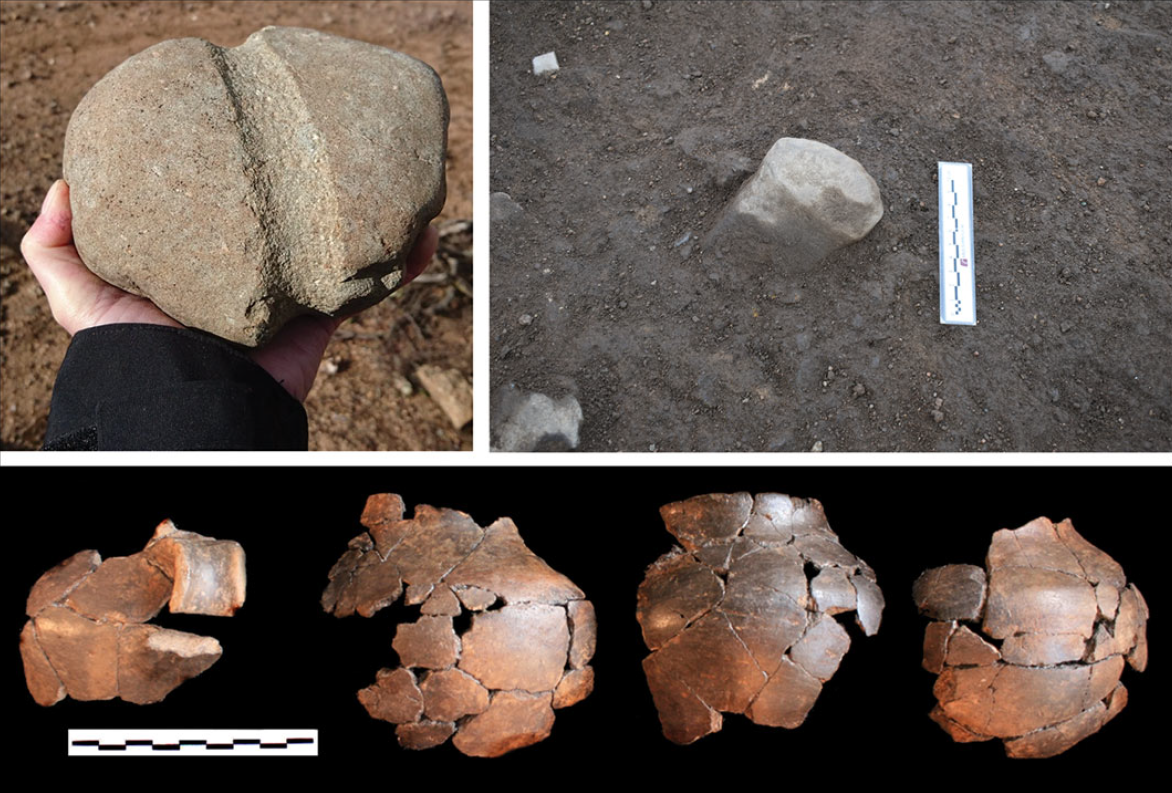
 Grooved stone mining hammers and Late Bronze Age pottery recovered from Las Minillas in south-western Spain, where extensive copper extraction took place between roughly 1300 and 800/700 BC.
Image Credit:
M. Díaz-Guardamino & Las Minillas Archaeological Team, in Latorre-Ruiz et al., Antiquity (2026)
A Bronze Age Copper Mine in Spain Reveals a Wider European Metal Network
New excavations at Las Minillas in south-western Spain have revealed one of the largest securely dated Late Bronze Age copper mines known in Iberia, strengthening the case that southern Spain became an important source of metal for networks that may have extended far beyond the Iberian Peninsula.
Las Minillas lies near Granja de Torrehermosa in Badajoz, where a copper-bearing outcrop extends for roughly 300 metres. Although prehistoric mining had been recognized there decades ago, systematic investigations beginning in 2020 have now provided extensive archaeological evidence and a series of radiocarbon dates that place major mining activity between approximately 1300 and 800/700 BC.
Excavations, geophysical survey and drilling revealed a long trench dug directly along the copper vein. The workings were generally two to four metres wide, while drilling indicates that some sections reached between seven and 16.5 metres deep. The ore appears to have been almost completely extracted before the workings were gradually filled with debris. Concentrations of charcoal at the bottom of one trench may indicate the use of fire-setting, a technique in which rock was heated so that thermal stress helped fracture it.
The scale of the labour is also reflected in the tools. Archaeologists documented 892 stone implements, including 735 grooved mining hammers, both on the surface and within excavated areas. Together with the size of the workings and the radiocarbon sequence, these finds make Las Minillas the largest securely dated Late Bronze Age copper mine excavated in Iberia so far.
Mining wasn’t the only activity taking place there. Excavation exposed the remains of a circular hut with postholes and hearths, accompanied by handmade pottery and Late Bronze Age radiocarbon dates. The structure appears to have been short-lived and may have belonged to a seasonal encampment used by people working the mine rather than to a permanent settlement.
A nearby area produced about 300 kilograms of slag, copper droplets and a possible furnace, showing that metallurgical activity also took place at Las Minillas. Its chronology, however, is complicated. Radiocarbon samples from this zone produced Roman and Islamic dates, while other evidence spans a broader period. The researchers therefore caution against automatically assigning the surviving smelting installations themselves to the Late Bronze Age.
The wider importance of the mine emerges from chemical and lead-isotope analyses. Copper ores, slags and metal droplets from Las Minillas carry geological signatures that can be compared with ancient bronze artefacts elsewhere in Europe. Among more than 300 Scandinavian Bronze Age objects examined in previous datasets, 11 artefacts showed isotope and chemical compositions consistent with copper represented at Las Minillas. Seven date to roughly 900–700 BC, overlapping closely with the latest documented phase of mining at the Spanish site.
This doesn’t prove that those objects were made specifically from Las Minillas copper. Similar geological signatures can occur elsewhere in southern Iberia, and the available comparative data remain incomplete. But the results add to growing evidence that copper from the peninsula entered long-distance exchange systems reaching Atlantic and northern Europe.
Las Minillas may also represent only one part of a much larger phenomenon. More than 80 prehistoric mining sites with comparable surface evidence are known in south-west Iberia, although only a small number can currently be securely dated to the Late Bronze Age. The study groups this potential network under the term Southern Iberian Copper Mining Complex, while stressing that considerably more dating and chemical analysis are needed before its full scale can be established.
Estimates suggest that Las Minillas alone may have produced at least 49 tonnes of copper, with higher calculations ranging to several hundred tonnes. If numerous mines across southern Iberia were operating at the same time, their combined production could have represented an important European source just as output from major mines in Wales and the Austrian Alps was declining.
The picture that emerges is therefore larger than a single mine. Las Minillas strengthens the possibility that southern Iberia became a significant copper-producing region during the Late Bronze Age, linked through renewed maritime networks to the Atlantic, the western Mediterranean and perhaps communities as distant as Scandinavia. The precise routes and quantities remain uncertain, but the mine provides new evidence that Iberia’s role in Europe’s Bronze Age metal economy may have been considerably greater than previously recognized.
Published on: 28-10-2026
Edited by: Abdulmnam Samakie
Source: Antiquity